


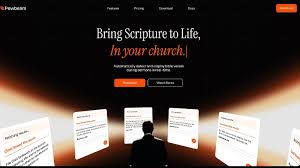
Dara Sobaloju, emerging Nigerian technologist, has officially launched PewBeam, an innovative AI-powered application designed to display Bible verses in real time during sermons, marking a bold step in bringing churches into the artificial intelligence era.

The idea began as a simple post on X on August 21, 2025. Sobaloju shared his vision of building a “Bible presentation AI agent” that could automatically display scripture as pastors preach, even when verses are paraphrased or loosely referenced.
Six months later, that vision has become reality. Announcing the launch, he wrote: “PewBeam is live.”
Now available as a desktop application for Windows and macOS, PewBeam has already been tested in live church settings over the past four weeks, with early adopters describing it as a game-changer.
At its core, PewBeam listens to a sermon in real time, interprets the message, and instantly projects the most relevant Bible verses on screen, often in under 80 milliseconds. In practical terms, this is virtually instantaneous, eliminating the need for media teams to manually search for scriptures or manage slides during services.
The result is a smoother, more immersive worship experience. Pastors can preach without interruption, while congregants follow along seamlessly, with scripture appearing exactly when referenced.
One early user summed up the impact: “PewBeam changed the way I follow sermons completely.”
The app’s journey from concept to launch reflects a modern, open-development approach. Sobaloju built PewBeam in public, sharing updates, gathering feedback from churches, and refining the product in real time. The result is not just a prototype, but a polished tool already tested in real worship environments.
While the current version focuses on real-time scripture display, the roadmap is ambitious. Full slide presentation features are expected soon, positioning PewBeam as a comprehensive church presentation platform. Sobaloju’s broader vision is to ensure that churches are not left behind as AI reshapes industries worldwide.
The pricing model also reflects this mission. PewBeam offers a free tier for small churches and fellowships, with paid plans adjusted based on location to ensure affordability across different regions, including underserved communities.
The innovation stands out for three key reasons.
First, its technical sophistication. Delivering accurate, context-aware scripture suggestions in real time requires advanced speech recognition, semantic understanding, and rapid data retrieval, capabilities that are difficult to combine effectively.
Second, its user-focused design. Unlike many church tech tools that force pastors to adapt to software, PewBeam adapts to the preacher’s style, allowing sermons to flow naturally without disruption.
Third, its timing. As AI adoption accelerates globally, churches have an opportunity to shape how the technology is used in faith settings. PewBeam represents an early example of AI being tailored to serve spiritual engagement rather than replace it.
However, challenges remain. The system’s accuracy across diverse accents, preaching styles, and Bible translations will need to be tested at scale. Questions around performance in noisy environments, compatibility with existing church audio systems, and data privacy will also be important as adoption grows.
Still, initial feedback has been overwhelmingly positive. With a transparent development approach and strong early traction, PewBeam is positioning itself as a pioneering tool at the intersection of faith and technology, redefining how scripture is experienced in modern worship.

