When the Afrobeat sensation first saw Lemi Ghariokwu’s work, he said, ‘Wow!’ Then he plied him with marijuana and asked him to design his album sleeves.
Ghariokwu had first crossed Kalakuta’s threshold three years earlier as an 18-year-old engineering student, accompanied by Kuti’s journalist friend Babatunde Harrison, who’d spotted Ghariokwu’s portrait of Bruce Lee hanging in a Lagos bar and deemed him skilled enough to illustrate the musician’s album sleeves. As he awaited his audience with the Black President, then mid-siesta, Ghariokwu absorbed his surroundings.
When Kuti finally awoke, Ghariokwu handed over the portrait of him that Harrison had requested. “Fela was groggy, his eyes were bloodshot, and he was dressed only in his briefs, which hung down so his whole pubic hair was exposed. I was intimidated. He looked at the portrait and said, ‘Wow. Goddammit.’ He wrote me a cheque for 120 naira, four times what I’d charge for a portrait. But my spirit told me, ‘Don’t take the money.’ I told him it was a gift from the bottom of my heart, and he smiled, writing me a gate pass to visit Kalakuta whenever I wanted. It was the ticket to my destiny.”
Kuti commissioned Ghariokwu to paint the sleeve for his next release, Alagbon Close, which railed against the regime’s dehumanisation of Nigeria’s people. “Alagbon Close was where Fela became a revolutionary against the system,” says Ghariokwu. “I didn’t simply illustrate the lyrics – my painting was more metaphysical. I depicted Fela breaking out of jail, in a celebratory stance, chains broken, the victory sign painted on the wall of Kalakuta because he’d triumphed over the evil police. When Fela saw it, again he said: ‘Wow. Goddammit.’ But I cashed the cheque this time.”
Kuti took the artist under his wing. “I was already a pan-Africanist,” Ghariokwu says. “But Fela taught me so much. He gave me books about African history, George GM James’s Stolen Legacy, Yosef ben-Jochannon’s Africa: Mother of Western Civilisation, and the Autobiography of Malcolm X. His other graphic designers didn’t care about what he was preaching. I did, and that put me in a very advantageous position.”
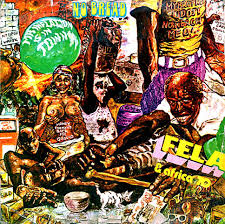
Kuti also wanted to open Ghariokwu’s mind to the powers of marijuana, but the teetotal artist was reluctant. “Some of the 80 or so people living in Kalakuta were employed simply to roll spliffs,” he remembers. “But I always refused. I took Fanta instead.” However, when Ghariokwu was assigned his second album cover, 1975’s No Bread, Kuti said: “How can my artist be drinking Fanta? You have to smoke igbó to make your head correct.” Ghariokwu adds: “He was such a hero to me, a demi-god, I said, ‘OK’.”
Kuti would get his chefs to heat marijuana until it yielded its oil, bottling and storing it in his bedroom. “It was very potent. He put a drop on the end of a spoon for me to lick. Within 30 minutes, I felt very hungry and I had this floating feeling. I went to the bathroom, and I could see my alimentary canal like the plumbing of a house, my urine travelling through pipes inside my body. I told Fela and his friends, and they all laughed at me.”
Later that day, Kuti realised that Ghariokwu needed to go home. “He drove us in his Range Rover, and when we got to my parents’ place, kids in the street were shouting, ‘Fela! Fela!’ As I got out of the car, he hissed, ‘When you get inside, don’t talk to your parents, don’t answer any questions – just say “goodnight” and go to sleep. But when you sleep, meditate about the artwork.’ I awoke at noon the next day. Ideas were just flooding my brain. I forced in as many as possible.”
The sleeve for No Bread presented a dizzying overload of images and metaphors: men fighting over food and money, women presenting their breasts, rats in sunglasses, empty petrol pumps, a balloon reading “Mr Inflation is in town”.
“When Fela saw it, he jumped for joy, shouting, ‘You see?’ like I should always have been smoking marijuana. But I can’t handle intoxicants. So I analysed the inspiration I got from that high and used it as my style of composition from then on.”
Ghariokwu remained teetotal, but his work continued to evolve over the next several years. On acidly satirical sleeves such as Ikoyi Blindness (lampooning a lawyer from the affluent Ikoyi neighbourhood), Yellow Fever (naked African women apply skin bleacher), Upside Down (colonial developers invade as children starve), Ghariokwu created a visual identity as unique as Pedro Bell’s work for Funkadelic. “Fela treated me like one of his children, always receiving my work with ‘Wow. Goddammit.’ And, if he was particularly impressed, ‘MOTHERFUCKER.’ I was his youngest adviser, his comrade-in-arms. With two other friends, I formed the political youth wing of Kalakuta, Young African Pioneers. Fela could no longer use public transport, so we told him what was happening in the city, and that inspired his songs.”
Ghariokwu was at home when a neighbour told him Kalakuta was on fire. He raced to the compound. Fela saw me and whispered, ‘Get my lawyer.’”
Ghariokwu and Kuti disagreed over how to proceed in the aftermath of the raid. “We had to be diplomatic, we needed to sit down and negotiate,” says Ghariokwu. “Fela was having none of that, and my loyalty was questioned.” When he painted a young African in denim and platform shoes falling from an aeroplane for the sleeve of Johnny Just Drop, which satirised diaspora Africans believing they’re superior to their countrymen, Kuti nixed the cover (“I don’t want it to seem like I’m attacking the youth”) and told Ghariokwu to draw a bourgeois older man in a parachute instead. It was the first time Kuti had told him what to paint. Against his boss’s wishes, Ghariokwu had the label manufacture an expensive gatefold sleeve with Kuti’s preferred image on the front and the rejected image on the back. “He was so angry,” he laughs. “‘You’ve hit me below the belt!’ I ran. The next day, he cooled down.”
But then Kuti rejected Ghariokwu’s next sleeve, for Sorrow, Tears and Blood. “Fela broke my heart,” says the artist, who had always enjoyed “100% freedom” in his work for Kuti. Ghariokwu walked away from Kalakuta, going on to complete more than 2,000 album sleeves for other musicians and pursue a career in fine art. A decade after their falling out, he reconciled with Kuti, working on several more sleeves before the Black President succumbed to Aids in 1997.
Culled from an article by Stevie Chick in the Guardian
Nicked from Babafemi Ojodu’s Facebook post