
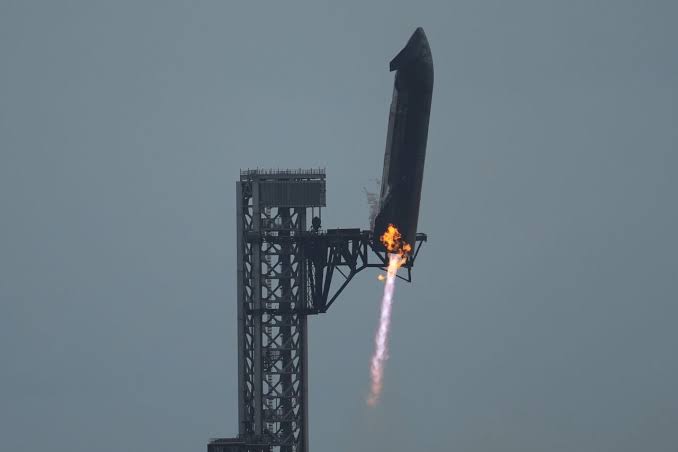
SpaceX has achieved a major milestone in reusable rocket technology after its Starship spacecraft successfully returned from orbit and was caught by the giant mechanical arms of its launch tower in South Texas.

The unprecedented manoeuvre, completed on Saturday, November 14, marked the first time in history that the upper stage of a rocket had been recovered through a pinpoint landing at its launch tower after a spaceflight. The 171-foot-tall Starship spacecraft, the upper stage of SpaceX’s massive Starship launch system, was caught by the launch tower’s mechanical arms, nicknamed “chopsticks”, at the company’s Starbase facility.
The achievement followed a 22-hour mission that began at 5:47 p.m. ET on Friday. During the flight, Starship reached Earth orbit, deployed Starlink internet satellites and completed 14 circuits of the planet before returning to Earth. The successful recovery is a significant step towards SpaceX’s goal of developing fully reusable rockets, which could substantially reduce the cost of launching payloads and people into space.
However, the mission was not without setbacks. A few minutes after launch, SpaceX attempted to guide the Super Heavy booster, the lower stage of the launch system, back to the launch tower for recovery. The attempt was unsuccessful, and the company redirected the booster for a splashdown in the Gulf of Mexico. SpaceX said the booster had insufficient fuel for the planned recovery.
The successful return of the Starship spacecraft nevertheless gives engineers an opportunity to examine the vehicle and assess how its components performed during the mission.
Particular attention will be paid to its heat shield, which protected the spacecraft from temperatures exceeding 2,000 degrees Fahrenheit during atmospheric re-entry. Engineers will also inspect its engines, nose cone and other systems to identify areas for improvement.
Reusability is central to SpaceX’s long-term ambitions. Recovering Starship could allow the company to refurbish and relaunch the spacecraft rather than build a new vehicle for every mission.
The milestone is also important to NASA’s plans to return astronauts to the Moon. SpaceX is expected to develop Starship technology for future lunar missions, including a planned test next year involving the docking of a Starship test vehicle with a NASA spacecraft.
The company has said it wants to achieve reliable reuse of Starship vehicles ahead of NASA’s Artemis IV mission, currently scheduled for 2028, which could return astronauts to the lunar surface for the first time since the Apollo programme.
Saturday’s achievement therefore represents more than a dramatic engineering feat. It moves SpaceX closer to its ambition of making large-scale space transportation more affordable and supporting future missions to the Moon and, eventually, Mars.