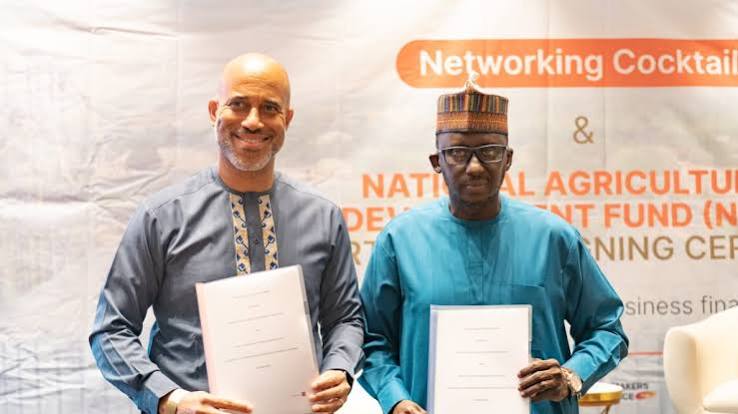
The National Agricultural Development Fund (NADF) has signed a Memorandum of Understanding (MoU) with Sahel Capital Fund Manager Limited to explore new financing arrangements aimed at improving access to affordable capital for small and medium-sized enterprises (SMEs) in Nigeria’s agricultural sector.

The partnership seeks to combine public-sector funding, private investment capital and technical expertise to unlock financing opportunities for agribusinesses, support business expansion and attract more investment into the sector.
Speaking at the signing ceremony, Muhammed Ibrahim, NADF Executive Secretary, described the agreement as a shift from conventional agricultural financing towards building a sustainable investment ecosystem capable of attracting long-term private capital.
He said NADF would contribute its development mandate and understanding of national agricultural priorities, while Sahel Capital would bring investment expertise, market knowledge and experience across agricultural value chains.
“Our goal is to create an investment ecosystem that combines public-sector capital with private-sector expertise to unlock more financing opportunities for agribusinesses,” Ibrahim said.
He explained that the proposed arrangement would blend public and concessional funding with private investment expertise to develop financing structures capable of attracting additional investors.
Although agriculture is often considered a high-risk investment, Ibrahim said appropriate financing arrangements and strategic partnerships could unlock significant opportunities across the sector.
Mezuo Nwuneli, Managing Partner of Sahel Capital, said the collaboration was expected to reduce borrowing costs for agribusiness SMEs by combining NADF funding with capital managed by the investment firm.
He noted that many agricultural businesses currently access loans at interest rates of between 24 and 27 per cent, making it difficult for them to expand operations and invest in growth.
The partnership, he said, would enable both institutions to provide financing at a lower blended cost, strengthening businesses’ capacity to scale.
“One output we expect is that when we’re providing capital to SMEs in the space, that blended cost for them would be much lower than what it would be,” Nwuneli said.
He added that the collaboration would also help identify major constraints across the agricultural ecosystem and deploy the institutions’ respective resources and expertise to address them.
Nwuneli said Sahel Capital was particularly interested in working with NADF because of its interventions in critical areas such as ginger production, farmers’ access to inputs and irrigation.
He described NADF as an institution committed to tackling structural challenges in agriculture, noting that its team had demonstrated the capacity and determination to implement meaningful interventions.
Sahel Capital, he disclosed, has made 45 investments across eight African countries over the past 15 years, providing growth equity and private credit to SMEs with annual revenues ranging from N500 million to N20 billion.
Under the MoU, both institutions will explore the feasibility of blended financing arrangements through which NADF could provide funding alongside capital managed by Sahel Capital, including the Sahel Agribusiness Private Debt Fund (SAPDF).
The proposed structure may incorporate risk-sharing mechanisms, concessional funding and other arrangements designed to improve access to affordable financing for eligible agribusinesses.
Sahel Capital is also expected to contribute investment structuring, fund management and technical expertise, identify eligible businesses, and establish monitoring and reporting frameworks for the proposed facility.
Other areas of potential collaboration include information sharing, development of a pipeline of bankable agribusiness projects, technical assistance and capacity building.
The agreement is expected to provide a framework for both institutions to explore ways of addressing financing constraints that have limited the growth of agricultural businesses and investment across Nigeria’s agricultural value chains.