


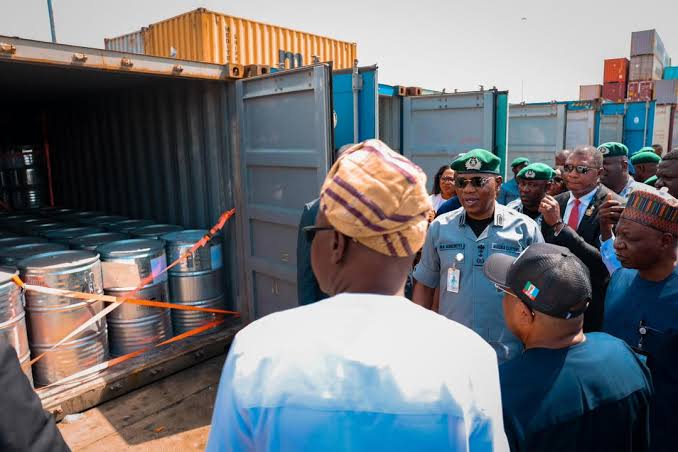
The Federal Government has secured the release of 98 containers of electricity transmission equipment that had been stranded at Nigerian ports for nearly 20 years, in a move expected to strengthen the national grid and support efforts to improve power supply.

The release followed a directive by President Bola Tinubu and approval by the Nigeria Customs Service, according to a statement by Joseph Tegbe, the Minister of Power.
The equipment, originally procured to expand the country’s transmission network, is expected to help ease pressure on overloaded substations, address infrastructure bottlenecks and facilitate the completion of stalled electricity projects.
The government is also working to secure the release of more than 200 remaining containers, bringing the total number of stranded containers to over 300.
Tegbe described the release of the first batch as an important step towards recovering critical infrastructure assets and addressing longstanding constraints in the electricity sector.
According to the minister, engineers will inspect, verify and test the equipment before deployment to locations where it is most urgently needed.
He explained that the equipment was procured to expand the transmission network, relieve pressure on overloaded substations and improve electricity delivery across the country.
“For nearly 20 years, over 300 containers of transmission equipment sat stranded at our ports.
“This equipment was bought to expand the network, relieve overloaded substations and bring more reliable electricity to Nigerians. Yesterday, the Nigeria Customs Service approved the release of the first 98,” Tegbe said.
He added that the government was working to secure the release of the remaining containers without further delay.
The Ministry of Power disclosed that an inspection had found most of the equipment useful and viable. Items requiring attention would be refurbished where necessary before being deployed to designated project sites.
The deployment is expected to support the completion of abandoned installations, ease pressure on overloaded substations and strengthen transmission corridors experiencing capacity constraints.
Tegbe credited President Tinubu with approving the release, while acknowledging the contributions of government officials and agencies involved in resolving the administrative and financial bottlenecks that had prevented the equipment from leaving the ports.
He particularly appreciated Taiwo Oyedele, Minister of Finance; Adegboyega Oyetola, Minister of Marine and Blue Economy; the Comptroller-General of Customs, the Nigerian Ports Authority, terminal operators and officials of the Ministry of Power and its agencies.
Adewale Adeniyi, Comptroller-General of Customs, said the release followed the President’s directive for immediate clearance and the resolution of outstanding charges and administrative issues.
He disclosed that the Service had begun working with the Ministry of Power, the Nigerian Ports Authority and terminal operators to facilitate the exercise.
Adeniyi also pledged continued cooperation until all the remaining containers were released, while appealing to terminal operators to support the process.
The development comes amid the Federal Government’s efforts to expand Nigeria’s electricity transmission infrastructure and address persistent constraints across the power value chain.
The Presidential Power Initiative (PPI), launched in 2019 under the administration of former President Muhammadu Buhari in partnership with Siemens Energy, is one of the major programmes designed to address bottlenecks in the country’s transmission and distribution networks.
In 2025, President Tinubu directed the expansion of ongoing power infrastructure projects under the initiative, with implementation structured into three phases.
The President subsequently reaffirmed his administration’s commitment to providing the political and financial support required to advance the programme during engagements with Siemens Energy executives.
The release of the stranded equipment is expected to complement these broader infrastructure expansion efforts.
However, the extent of its impact on electricity supply will depend on how quickly the equipment is inspected, refurbished where necessary, installed and integrated into the national transmission network.
For a country grappling with persistent electricity shortages and transmission constraints, recovering equipment that has remained idle at the ports for nearly two decades represents an opportunity to put previously committed public resources to productive use.

