
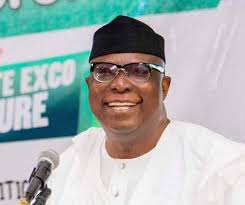
…A Tribute to Lade Bonuola at 80
By Babafemi Ojudu
There are journalists, and there are journalists who make other journalists. Mr Oyinlade Bonuola, Lade Bonuola to the public and Ladbone to generations of Nigerian newspapermen and women, belongs firmly to the latter category.
He is what I would describe, without hesitation, as a journalist’s journalist: a consummate professional, a teacher of teachers, an editor of editors and one of the great custodians of the values that once made the Nigerian press a formidable institution.
Ladbone was not merely part of our professional upbringing; he was its backbone. He taught us how to report, how to edit, how to write editorials, how to plan pages and, above all, how to respect facts. He was a master of every department of newspaper production. Indeed, if journalism were a human body, he would be part of its skeleton—the structure that holds everything together while remaining largely unseen.
That is why I have chosen to call him the bone of our bones.
He turned 80 today October 22 ,2026. Eighty years is a milestone for anyone, but for a journalist it is also an archive: eight decades of observation, inquiry, judgement, discipline and memory. In Ladbone’s case, it represents more than half a century devoted to the pursuit of excellence in Nigerian journalism.
His journey began far from the noise and glamour that people sometimes associate with the press. He grew up in Kishi, in present-day Oyo State, and later attended Ijebu-Ode Grammar School for his Higher School Certificate. Even in those early years, the intellectual promise was evident. He reportedly won the John F. Kennedy zonal essay competition while at the school. The young man from Kishi was already demonstrating the command of language and clarity of thought that would later become the hallmarks of his professional life.
In February 1971, he joined the Daily Times as a trainee sub-editor. Those were the glorious days of the Daily Times, when the newspaper was not merely a place of employment but an academy of journalism. The newsroom was populated by some of the finest minds the profession had produced, and standards were uncompromising. A young sub-editor was expected to be widely read, informed about events at home and abroad, sensitive to language and able to detect a weak fact, a clumsy sentence or a hole in a story almost by instinct.
Ladbone absorbed those traditions and perfected them. He also benefited from professional training in the United Kingdom, particularly in the use of language and the presentation and packaging of news. At the Daily Times, he worked away from the limelight, polishing the raw copies of reporters and turning them into clear, compelling and credible accounts of the day’s events.
That is the peculiar fate of the great sub-editor. The reporter receives the byline and, sometimes, the applause. The sub-editor remains anonymous. Yet it is often the sub-editor who rescues the reporter from embarrassment, saves the newspaper from litigation and protects the reader from confusion. Ladbone belonged to that old puritanical school in which the quality of the newspaper mattered more than personal visibility.
His movement to the features desk brought him greater recognition, but it was his celebrated column, Caught Out: A Critical Look at the Nigerian Press, published in the Sunday Times in the late 1970s, that established the legend of Ladbone. The pen name itself was cleverly fashioned from parts of his first name and surname.
In that column, no newspaper was above scrutiny. Ladbone exposed errors of grammar, syntax, fact, logic and presentation. Long before the term “media accountability” became fashionable, he had appointed himself an ombudsman for the Nigerian press. His criticism was not motivated by malice or rivalry. It arose from his conviction that those who demanded accountability from governments and public officials must themselves submit to rigorous standards.
He understood a simple but frequently neglected truth: the press cannot credibly ask society to be better than the press itself is willing to be.
His columns were incisive, economical and devastating without being abusive. One admirer, Uthman Shodipe-Dosunmu, later described his prose as pointed, striking and pithy, possessing the kind of effortless simplicity that only the truly gifted can command. Colleagues did not merely read Caught Out; they studied it. Editors awaited it with a mixture of anticipation and anxiety, wondering which error Ladbone’s unblinking eye would expose next.
At the Daily Times, he rose from sub-editor to production editor, features editor and eventually editor. He was also part of the distinguished group that established one of the earliest substantive editorial boards in Nigerian newspaper history. The Daily Times gave him his foundation, but it was at The Guardian that his gifts reached their apogee.
Ladbone moved from the Daily Times in 1982 to become a founding member and pioneer Associate Editor of The Guardian. He worked alongside such formidable figures as Dr Stanley Macebuh, Femi Kusa, Ted Iwere, Sonala Olumhense and Onwuchekwa Jemie. Together, they did not simply establish another newspaper; they helped redefine newspapering in Nigeria.
He became Editor, then Editor-in-Chief and, in 1989, Managing Director, a position he held until 1999. Under the leadership of Ladbone and his distinguished colleagues, The Guardian became the flagship of Nigerian journalism—not merely by proclaiming itself so, but by earning the description every morning.
The paper brought together intellectual depth, rigorous reporting, elegant prose, thoughtful editorials and meticulous production. Its pages became a national classroom. Its editorial board was an assembly of some of the finest minds in the country. Its reporters were encouraged to dig deeper, ask harder questions and resist easy explanations.
For those of us who passed through that tradition, Ladbone was like a god. When he emerged from his office and walked through the newsroom, moving quietly from desk to desk, you became suddenly conscious of everything you had written. You wondered what he thought of your copy, your headline, your choice of words and your judgement of the news.
He was not given to extravagant facial expressions. You could not easily tell whether he was pleased or disappointed. His words came slowly and sparingly, like the pronouncements of a sage. He did not need to shout. The authority was in the precision of his observation.
Dr Okey Ikechukwu, writing about him, noted that Ladbone never relied on the volume of his voice to win an argument. What he did not push with decibels, he pushed with the rigour of his reasoning. He could stand alone in an editorial board meeting and defend a position calmly, logically and courageously. He made no concessions to mediocrity.
He was also a rare talent hunter. He recognised brilliance wherever he encountered it and was not constrained by ethnicity, religion, age or pedigree. He read people’s work from afar, sought them out and gave them platforms. Shodipe-Dosunmu recalled that Ladbone invited him to join The Guardian Editorial Board in 1993 simply because he had been reading his work and noticed when he stopped writing. Ikechukwu similarly recalled being shown around The Guardian by Ladbone and being offered a place on the Editorial Board even though he had submitted no application.
That was Ladbone: an editor forever searching for talent, a gardener carrying a watering can, nurturing minds and preparing people for responsibilities they sometimes did not yet know they could shoulder.
The people he and his colleagues trained would later populate the most important newsrooms in the country. Many became editors, columnists, publishers and journalism teachers. Some of us went on to confront military dictatorship, campaign for democracy, defend civil liberties and insist that the rights of Nigerians must not be trampled upon. The courage displayed by that generation did not arise from nowhere. It was nourished in newsrooms where facts were sacred, public interest was paramount and ethical journalism was regarded almost as a religious obligation.
Ladbone belonged to the generation that taught us that journalism was not stenography. The journalist was not employed merely to record what the powerful had said. He was expected to interrogate it, place it in context and, where necessary, expose its falsehood.
Under his watch, The Guardian also introduced several innovations. The newspaper published the court Cause List, flight schedules under Flight Guardian, a children’s page associated with the pioneering writer Mabel Segun, Motoring Guardian and religious columns that reflected Nigeria’s plurality. Pastor Enoch Adeboye wrote Sunday Worship, while a Muslim cleric was sought to provide Friday Worship. These initiatives showed an editor thinking not only about politics and government but about the varied intellectual, spiritual and practical needs of the reader.
His greatness was never accompanied by pomposity. The DAME Awards described him as possessing a “pastoral air” that understated the depth of his pen—a man so simple that one could miss him in a crowd. Yet, in the newsroom, his hurried walk conveyed the urgency of the task. He moved as though walking leisurely was a sin when a newspaper had to be produced and delivered without compromising its integrity.
He was respected across the profession: by those senior to him, by his contemporaries and by those of us who were very junior to him. Such universal respect is difficult to earn in journalism, a profession richly populated by strong egos and stubborn opinions. Ladbone earned it because everyone recognised his competence, integrity and consistency.
After leaving The Guardian, he did not turn his back on the profession. He co-founded The Comet and became its first Managing Director, making another attempt to nurture a new generation of committed journalists and expand the frontiers of quality newspapering. He later served as publisher of the Nigerian Compass, before settling into the roles of consultant, columnist and elder of the profession.
One must be careful in speaking of Ladbone’s “retirement”. Journalists of his kind do not truly retire. They may stop attending daily editorial meetings or worrying about whether the first edition will catch the distribution vans, but they do not stop observing society. They do not stop reading, questioning, correcting and writing. The newsroom may release them, but journalism never does.
Even in his later years, Ladbone continued to write and comment on public affairs. He remained an advocate of a strong, ethical and responsible press, warning that changing technologies could never abolish the obligation to truth. In an age in which speed frequently triumphs over verification and social media noise is confused with public knowledge, his example has become even more relevant.
His contribution has been recognised with major honours, including the 2020 Lifetime Award for Journalistic Excellence from the Wole Soyinka Centre for Investigative Journalism and the DAME Lifetime Achievement Award. The DAME citation fittingly described him as a defender of professional standards, an advocate of a strong and responsible media and a courageous patriot committed to the search for meaning and morality in public life. The Wole Soyinka Centre and DAME Awards both preserve records of those honours.
But the greatest award Ladbone has received is not a plaque on a wall. It is the vast army of journalists who carry fragments of his teaching in their work. It is found in the reporter who checks a fact one more time before submitting a story; the sub-editor who removes ambiguity from a sentence; the editor who refuses to publish an unverified allegation; the editorial writer who insists on logic rather than abuse; and the newsroom leader who identifies a young talent and gives it room to grow.
As Ladbone attained the age of 80, we celebrated not merely longevity but consequence. We celebrated a life that has mattered and a career that helped define an era.
The Nigerian press today faces enormous challenges. Economic pressures have weakened newsrooms. Technology has disrupted old business models. Social media has democratised expression but also multiplied falsehood. Partisanship increasingly masquerades as journalism, while speed and sensation threaten accuracy and reflection.
In such a moment, the life of Lade Bonuola reminds us of the essentials: facts must remain sacred; language must be clear; power must be questioned; talent must be nurtured; and journalism must retain the moral courage to examine itself.
Ladbone was our teacher, our standard-bearer and our silent examiner. He was the presence that made a young journalist sit up when he entered the newsroom. He was the hand that turned rough copy into readable prose and eager recruits into formidable professionals.
He was our backbone.
He remains the bone of our bones.
Happy 80th birthday, Mr Lade Bonuola—journalist of journalists, editor of editors and enduring guardian of the finest traditions of the Nigerian press.