


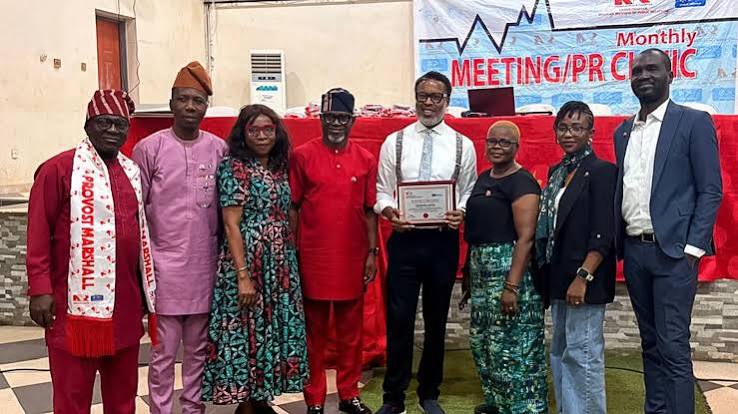
Dr Ike Neliaku, President of the Nigerian Institute of Public Relations (NIPR), and media personality Sulaiman Aledeh have called on journalists and public relations practitioners to play a more strategic role in rebuilding Nigeria’s reputation through credible reporting, constructive storytelling and evidence-based communication.

They made the call at the monthly meeting and PR Clinic of the NIPR Lagos Chapter, held at LTV 8, Lagos, on the theme, “Rebuilding Nigeria’s Reputational Currency with Media as a Tool.”
Neliaku, who joined the programme virtually, said Nigeria needed a deliberate and coordinated approach to reputation management rather than allowing negative narratives, stereotypes and misinformation to shape perceptions of the country.
He stressed that national reputation was not the exclusive responsibility of government but a collective obligation shared by citizens, institutions, businesses and other stakeholders.
“Reputation is not only about government. It is owned by the people, built by the people, and told through their actions and inactions. So, it is a collective responsibility,” he said.
Neliaku explained that the NIPR established the Nigeria Reputation Management Group (NRMG) to provide a coordinated framework for protecting and enhancing the reputation of individuals, organisations and the country.
He said the initiative focuses on reputation intelligence and media monitoring, youth mobilisation and training, strategic messaging, brand storytelling, national talking points, mentoring and the management of reputational threats.
According to him, the group aims to “protect, enhance and defend the reputation of individuals, organisations and Nigeria through proactive strategies, expert counsel and innovative solutions.”
The NIPR president urged communication professionals to challenge the persistent negative stereotypes associated with Nigeria by giving greater visibility to the country’s strengths in creativity, innovation, entrepreneurship, resilience, hospitality and cultural diversity.
“Why don’t we project and promote those positive ones as other nations are doing? They all have their problems. The only thing is that they manage their problems differently from how we manage our own challenges,” he said.
He encouraged practitioners to tell authentic Nigerian stories drawn from their communities, organisations and personal experiences, arguing that a one-dimensional portrayal of the country failed to reflect its potential and contributions.
“Nigeria is a world-class country when it comes to creativity and innovation. We have done so much with our creative economy. Our innovation and resilience have really shown that we have something that we can offer to the world,” Neliaku said.
Speaking from the perspective of journalism and the media, Aledeh said rebuilding Nigeria’s reputation required more than public relations campaigns or efforts to suppress negative publicity.
He argued that media, public relations and reputation management were closely connected, adding that practitioners had a responsibility to establish facts, identify problems and contribute to solutions.
Aledeh challenged journalists and PR professionals to uphold truth and professional integrity, even when doing so might be uncomfortable for employers, clients or political principals.
He maintained that constructive journalism should not shield institutions from scrutiny but should accurately report problems while examining credible efforts to address them.
Using a recent publication by The Economist on Nigeria as an example, Aledeh questioned whether Nigerian institutions and communication professionals had adequately responded to narratives portraying citizens as dissatisfied with their president but unable to change their political circumstances.
He warned that such narratives could gain traction when institutions failed to respond promptly or engage with the evidence behind them.
Aledeh said rebuilding Nigeria’s reputational currency must begin with a fundamental principle of journalism: ensuring that headlines accurately reflect the evidence presented in a story.
“Does the headline match the evidence?” he asked, cautioning journalists against sensationalism driven by clicks and monetisation in an increasingly competitive digital media environment.
He urged practitioners to interrogate sweeping claims, assess the evidence supporting them and challenge inaccurate or exaggerated portrayals, including those published by prominent international media organisations.
Aledeh also warned that the growing influence of untrained digital content creators and sensationalist platforms could undermine responsible public communication when the pursuit of attention takes precedence over accuracy and public interest.
He stressed that constructive journalism was not propaganda or an attempt to conceal Nigeria’s challenges. Rather, it involved reporting problems honestly while highlighting the people, innovations and initiatives working to resolve them.
He further urged public relations professionals to provide candid advice to their principals instead of merely crafting messages intended to make individuals and institutions look good.
WPRF to provide global platform
Neliaku linked the discussion to the forthcoming World Public Relations Forum (WPRF), which he said would offer Nigeria an opportunity to engage the international communications community and present a broader picture of the country.
According to him, the forum is expected to attract about 3,000 delegates from more than 156 countries, including policymakers, communication professionals, business leaders and representatives of international organisations.
He said the event would also provide an opportunity to strengthen engagement between public relations practitioners and the policymakers, businesses and institutions that rely on communication solutions.
Neliaku challenged practitioners to become “the vanguard of a new Nigerian story” and “the architects of national pride.”
He emphasised that improving Nigeria’s reputation would require sustained and coordinated action across sectors, with citizens and communication professionals contributing to how the country is represented at home and abroad.
The speakers’ call underscored the need for a balanced approach to national reputation: one that confronts genuine challenges with honesty while ensuring that Nigeria’s achievements, creativity and efforts to address its problems receive credible attention.

