


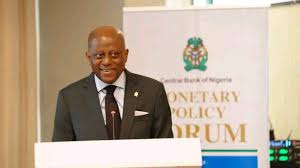
Olayemi Cardoso, Governor of the Central Bank of Nigeria, has revealed that 32 Nigerian banks have already met the new minimum capital requirements under the ongoing recapitalisation programme, marking a major milestone for the sector.

Speaking at a Monetary Policy Forum in Abuja, Cardoso described the level of compliance as “commendable,” noting that it significantly strengthens the banking system’s ability to support long-term investment and economic growth.
He emphasised that the recapitalisation drive is central to Nigeria’s ambition of building a $1 trillion economy, positioning banks to mobilise capital more effectively and support productive sectors of the economy.
According to him, the exercise is part of a broader reform agenda aimed at improving governance, enhancing risk management, and ensuring long-term financial stability. Key measures introduced include a risk-based capital framework, a phased exit from regulatory forbearance, stricter enforcement of insider lending rules, and tighter restrictions on credit for major non-performing obligors.
Cardoso also noted that supervisory capabilities have been strengthened through the deployment of digital tools, including enhanced early warning systems, improved off-site monitoring, and stronger oversight of Nigerian banks operating across borders.
On inflation, the CBN governor said aggressive monetary tightening played a decisive role in reversing price pressures. Headline inflation dropped sharply from 34.8 per cent in December 2024 to 15.06 per cent in February 2026, following cumulative rate hikes of 875 basis points in 2024 before a gradual easing cycle began. The policy rate was subsequently reduced to 26.5 per cent in February 2026.
In the foreign exchange market, Cardoso disclosed that the apex bank cleared over $7 billion in verified FX backlogs and introduced a rule-based willing-buyer willing-seller system to improve transparency. These reforms, alongside tighter reporting standards and improved market surveillance, helped narrow the gap between official and parallel market rates to below 2 per cent.
He added that diaspora remittances have become a key pillar of FX inflows, rising from about $200 million monthly to $600 million. The CBN is targeting $1 billion in monthly remittances by the end of 2026, reflecting growing confidence in the system.
External reserves have also improved significantly, rising to $50.12 billion in February 2026 from $38.34 billion a year earlier, while net reserves surged to $34.80 billion in 2025. Cardoso attributed this to better reserve management, diversification strategies, including gold integration, and stronger external asset frameworks.
On fiscal coordination, the CBN governor said reforms to curb Ways and Means financing have restored discipline. Outstanding advances dropped from N26.95 trillion in May 2023 to N2.84 trillion by January 2026, reinforcing central bank independence and reducing fiscal pressures.
He noted that Nigeria’s reform trajectory has attracted global recognition, including improved sovereign ratings from international agencies and the country’s exit from the Financial Action Task Force grey list in October 2025.
Looking ahead, Cardoso said the next phase of reforms will focus on consolidating gains by targeting single-digit inflation, maintaining exchange rate stability, and strengthening external reserves. He projected economic growth of 4.49 per cent in 2026, while cautioning against global risks such as geopolitical tensions and oil price volatility.
Despite these uncertainties, he expressed confidence that improved policy coordination and stronger macroeconomic fundamentals would sustain Nigeria’s economic recovery.
The recapitalisation programme has already seen Nigerian banks raise about N4.61 trillion in fresh capital, underscoring strong investor confidence and growing participation from foreign investors.
