


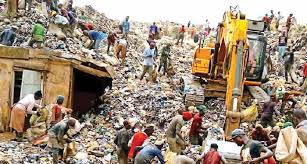

Nigeria is losing more than $100 million every year to inefficiencies in waste management, but experts say the country could transform the sector into a billion-dollar industry with the right governance reforms.
Igwebuike Ijeoma, a global climate governance expert and Nigeria’s Country Representative for the World Council for Renewable Energy (WCRE), says the core problem is not waste, but how the sector is governed.
“The challenges in Nigeria’s waste sector are structural,” Ijeoma told BusinessDay. “At the foundation is a governance issue. Government is acting as both operator and regulator, and that conflict has stalled progress.”
She compared the situation to the oil and gas sector, where the government’s dual role in NNPC joint ventures weakened regulation and enforcement. “It is like flogging yourself. Until these roles are separated, meaningful progress will remain limited,” she said.
Nigeria currently operates a linear waste system, focused on collection and dumping. Ijeoma advocates a shift to a circular resource-recovery model, where waste is converted into energy, fuel, and agricultural inputs.
Her firm, Schrodinger Greentech, has developed a framework to help states transition to this model by attracting private investment and tapping into global climate finance, estimated at $1.5 trillion.
“We have no properly engineered sanitary landfills in Nigeria. Most cities rely on open dump sites, some abandoned for over a decade,” she said. “In Wales, methane from a decommissioned dump site generates four megawatts of electricity. That model can be replicated here, for power generation, clean cooking gas, and organic fertilisers.”
According to Ijeoma, Nigeria has lost nearly $1 billion over the past decade from plastic waste alone. With the right legal and institutional framework, those losses could be recovered and potentially matched within five years.
“An efficient system will reduce wasteful government spending and generate revenue,” she said. “Investors are looking for readiness, clear laws, structure, and accountability. Once those are in place, data and capital will follow.”
She noted that environmental management is on Nigeria’s concurrent legislative list, giving state governments the authority to independently reform their waste sectors.
“Governors must take personal responsibility for building efficient, circular waste systems in their states,” she said.
Beyond revenue, Ijeoma highlighted the job-creation potential. “Each state can create at least 5,000 green jobs. If every local government deploys just 1,000 workers, we are talking about hundreds of thousands of jobs nationwide.”
She also challenged authorities in Abuja to rethink their approach. “Waste management is not just about paying contractors to evacuate refuse. Where the waste ends up matters. Without engineered landfills, it becomes a serious public health risk.”
Concluding, Ijeoma stressed that reform must begin with governance: “This is the taproot issue. Until the operator-regulator conflict is resolved, every solution will be temporary. But if states step up, Nigeria can unlock both economic and environmental value.”
If implemented, she believes Nigeria could turn its waste sector from a billion-dollar loss into a globally competitive, multibillion-dollar industry.

