


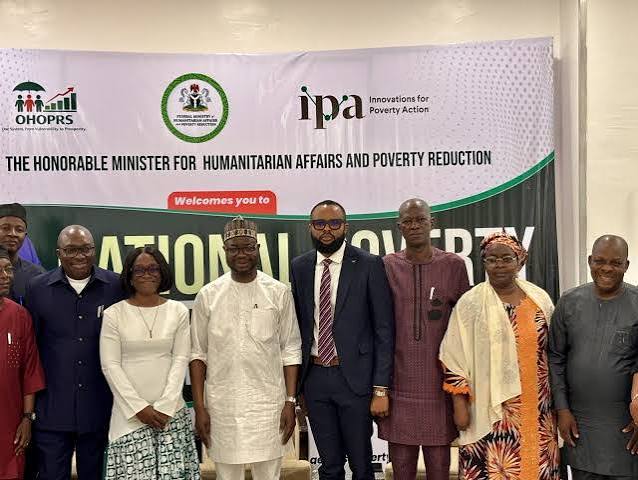
The Federal Government has launched the National Poverty Intelligence Lab (NPIL), a new data-driven platform designed to transform how Nigeria understands, measures and responds to poverty.

Dr. Bernard Doro, Minister of Humanitarian Affairs and Poverty Reduction, said the initiative will provide the intelligence needed to ensure anti-poverty policies deliver measurable and lasting results.
Speaking at the unveiling of the NPIL during a three-day workshop in Abuja, Doro described the platform as a major reform that would strengthen evidence-based policymaking and improve coordination across poverty reduction programmes.
The workshop, organised by the Ministry in collaboration with Innovations for Poverty Action (IPA), is focused on equipping stakeholders with the tools and methodologies required to utilise the new intelligence platform.
“Nigeria faces one of the most complex poverty challenges in the world,” Doro said.
“The poverty challenges in Nigeria have accumulated over several decades. What the Federal Government seeks to achieve is to ensure that policies and programmes targeted at the poor produce the desired results.”
According to the minister, the National Poverty Intelligence Lab will serve as the intelligence backbone of Nigeria’s poverty reduction architecture by providing reliable data to guide decision-making, monitor outcomes and improve programme effectiveness.
He said the initiative aligns with President Bola Tinubu’s Renewed Hope Agenda, which seeks to move the country beyond short-term interventions to sustainable poverty reduction.
“The Renewed Hope Agenda calls us to a higher standard. We are moving from palliatives to pathways, from fragmented projects to integrated systems, from measuring spending to measuring outcomes, and from dependency to dignity,” Doro said.
He explained that every household reached under the government’s One Humanitarian One Poverty Response System (OHOPRS) would be supported with the goal of permanently escaping poverty rather than receiving temporary relief.
“Every household we reach through the OHOPRS is a household we intend to graduate from vulnerability—not just today but permanently. The NPIL is the engine that will tell us whether we are achieving that objective,” he added.
Doro stressed that poverty cannot be effectively addressed through isolated programmes lacking coordination, accountability and reliable data.
He described the NPIL and OHOPRS as complementary reforms that would replace fragmented interventions with a unified national system.
“Through OHOPRS, we are building the systems. Through the NPIL, we are building intelligence. Together, they will help Nigeria move from fragmented interventions to coordinated outcomes, from palliatives to pathways, and from vulnerability to prosperity,” he said.
According to the minister, the NPIL represents not only a technological innovation but also a governance, accountability and systems reform designed to improve public service delivery.
He reaffirmed the Federal Government’s commitment to reducing poverty through sustainable, evidence-based policies capable of improving the quality of life of millions of Nigerians.
Mrs. Fumi Ayeni, Country Representative of Innovations for Poverty Action (IPA), said the partnership seeks to better understand the needs of poor and vulnerable Nigerians while reducing duplication in poverty intervention programmes.
She said the initiative would enable policymakers to develop more effective strategies and leave a lasting legacy in the country’s fight against poverty.
“Getting people out of poverty requires collective action. This collaboration will help ensure interventions are based on evidence and respond to what vulnerable communities actually need,” Ayeni said.
Dr. Abimbola Fasanu, Senior Technical Adviser to the Minister on Information Systems and Data Analysis, said participants at the workshop include representatives of development partners, government agencies and humanitarian organisations.
According to her, the project will strengthen the ministry’s capacity to make faster, smarter and more measurable decisions.
“Data is not just a bureaucratic requirement; it is a strategic national asset,” Fasanu said.
She noted that the initiative would also make reliable poverty data accessible to development partners, the private sector and individuals interested in supporting humanitarian programmes.
