
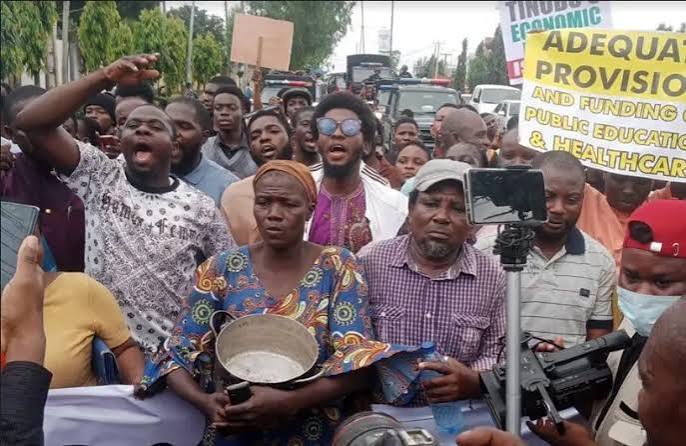
The IMF’s recommendation that Nigeria impose excise duties on telecommunications services and extend VAT to petroleum products raises a fundamental question: How do you tax people deeper into poverty and then promise to help them with social interventions?

That logic is difficult to defend.
That is precisely where the IMF’s latest recommendation runs into trouble.
The contradiction is glaring. In the same report, the IMF acknowledges that poverty remains widespread, food insecurity is increasing, inflation continues to strain household budgets, and millions of Nigerians are struggling to cope with the aftermath of fuel subsidy removal and currency depreciation. Yet the proposed solution is to place additional taxes on two services that have become essential to modern life: fuel and telecommunications.
Fuel is no longer a luxury item. It powers transportation, agriculture, manufacturing, commerce and even electricity generation in many homes and businesses. Every increase in the cost of fuel quickly finds its way into food prices, transportation fares, school fees, medical costs and the prices of virtually every good and service.
Telecommunications have become equally indispensable. Mobile phones and internet connectivity are now the backbone of economic participation. Traders use them to reach customers. Students depend on them for learning. Farmers access market information through them. Small businesses process payments through them. Digital entrepreneurs rely on them for their livelihoods.
Taxing these sectors further is, in effect, taxing productivity itself.
Perhaps the most puzzling aspect of the IMF’s recommendation is the accompanying suggestion that government should protect vulnerable citizens through social intervention programmes and cash transfers.
This raises an obvious question: why take more money from struggling citizens only to create another bureaucracy to return a portion of that money to some of them?
Nigeria’s experience with social intervention programmes has been mixed at best. Questions persist about the credibility of social registers, the efficiency of distribution mechanisms, the transparency of beneficiary selection and the prevalence of leakages.
Many of those who would bear the burden of higher taxes may never receive any compensatory support.
The result could be a system where the pain is immediate and universal, while the relief is limited and uncertain.
The larger issue is that Nigeria’s challenge is often wrongly described as a revenue problem alone. It is equally a spending problem, an efficiency problem and a governance problem.
There is no doubt that Nigeria’s tax-to-GDP ratio remains among the lowest in the world. However, citizens are increasingly asking a different question: what has happened to the revenues already collected?
The larger issue is that Nigeria’s challenge is often wrongly described as a revenue problem alone. It is equally a spending problem, an efficiency problem and a governance problem.
Why does the cost of governance remain so high? Why do multiple government agencies continue to perform overlapping functions? Why are public officials still surrounded by expensive convoys, foreign trips and luxury perks at a time when citizens are being asked to tighten their belts?
Why do oil theft, customs leakages and revenue losses persist despite repeated promises of reform?
Before government seeks more money from citizens, there must be visible evidence that existing resources are being used prudently.
This is particularly important when discussing VAT.
VAT is often described as one of the most efficient taxes in the world. That may be true in countries with strong social safety nets, reliable public services and relatively high incomes. In Nigeria, however, VAT tends to hit the poor harder than the rich.
A wealthy executive and a struggling artisan may pay the same VAT rate, but the burden is far heavier on the person with lower income.
Extending VAT to fuel products would trigger a chain reaction across the economy. Transport costs would rise. Food prices would increase. Production expenses would climb. Small businesses would face additional pressure. Ultimately, consumers would pay more for everything.
At a time when inflation is already eroding purchasing power, such a move would amount to pouring fuel on an already raging fire.
The same concerns apply to telecommunications.
For years, government has promoted financial inclusion, digital transformation, innovation and the knowledge economy. Telecom operators have invested billions of naira in infrastructure to connect millions of Nigerians.
Yet the industry continues to complain about multiple taxation and regulatory burdens.
Adding telecom excise duties would increase operating costs, discourage investment and make connectivity more expensive for consumers. It would undermine the very digital economy that policymakers claim to be building.
If Nigeria genuinely seeks greater fiscal sustainability, there are better options available.
The first is to reduce the cost of governance. Significant savings can be achieved by eliminating waste, reducing unnecessary agencies, streamlining public institutions and cutting excessive political appointments.
The second is to expand the tax base rather than increase tax rates. Millions of economic activities remain outside the formal tax net. Bringing more businesses into the formal economy would generate sustainable revenue without overburdening those already paying taxes.
Third, government must tackle leakages aggressively. The billions lost annually through oil theft, illegal mining, customs fraud and weak revenue collection systems far exceed what many new taxes would generate.
Fourth, Nigeria should focus on unlocking the value of underutilised public assets. Vast tracts of government-owned land, buildings and enterprises could be commercialised, concessioned or restructured to generate income.
Most importantly, government must prioritise economic growth.
Prosperity creates revenue more effectively than taxation. When businesses thrive, jobs are created. When jobs are created, incomes rise. When incomes rise, tax collections increase naturally.
The most sustainable way to improve government revenue is to grow the economy, not to squeeze citizens already struggling under the weight of economic hardship.
Nigeria undoubtedly needs more revenue. Few would dispute that. But the country cannot tax its way into prosperity.
The real challenge is not simply that government collects too little. It is that too much is wasted, too much is lost and too little is translated into meaningful improvements in the lives of ordinary citizens.
Before introducing VAT on fuel or reviving telecom taxes, policymakers should focus on demonstrating that every naira already collected is being managed efficiently, transparently and responsibly.
That would not only improve public trust; it would provide a far stronger foundation for any future discussion about taxation.
Until then, taxing hardship cannot be the answer to hardship.
taxing hardship cannot be the answer to hardship.