


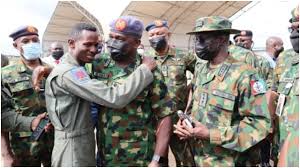
Nigeria’s military expenditure surged by 55 per cent to $2.1 billion in 2025, driven by escalating insecurity across the country, according to a new report by the Stockholm International Peace Research Institute.

The increase, from about $1.35 billion in 2024, places Nigeria among the fastest-growing military spenders globally and the second-largest in sub-Saharan Africa, behind South Africa.
The report links the sharp rise to intensifying security challenges, including insurgency in the North-East, banditry in the North-West, and ongoing communal and separatist tensions.
Nigeria’s spending played a major role in pushing total military expenditure in sub-Saharan Africa to $23.3 billion in 2025, a 7.4 per cent increase from the previous year.
Over the past decade, defence spending in the region has grown by 21 per cent, reflecting persistent instability and conflict risks.
While Nigeria ramped up spending, South Africa, the region’s top spender, cut its military budget slightly by 1.2 per cent to $3.2 billion.
Across Africa, military expenditure reached $58.2 billion in 2025, up 8.5 per cent year-on-year and 45 per cent higher than in 2016, with North African countries accounting for the largest share.
Globally, defence spending hit a record $2.887 trillion in 2025, marking the 11th consecutive year of growth, although the pace of increase slowed compared to 2024.
The world’s top five spenders, the United States, China, Russia, Germany, and India, accounted for 58 per cent of total global military expenditure.
Nigeria’s rising defence budget underscores a growing shift in fiscal priorities toward security, even as the country faces mounting economic pressures.
Analysts warn that sustained increases in military spending could limit funding for critical sectors such as infrastructure, healthcare, and education.
The country’s expanding defence investment also reflects its broader military capacity, including a fleet of 159 aircraft supporting counter-terrorism, surveillance, and operational logistics nationwide.

