


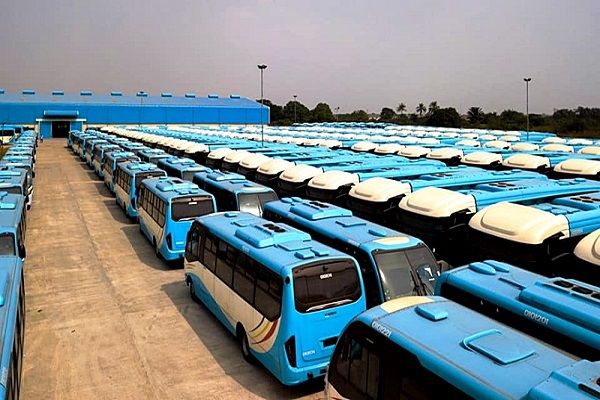
Oando Clean Energy has partnered with the Lagos State Ministry of Transportation to roll out 3,000 electric buses by 2030. Mr. Ademola Odunbanjo, Executive Vice President Oando Clean Energy, disclosed this at the ongoing ninth edition of the Lagos Climate Change Summit in Lagos, Wednesday.
The News Agency of Nigeria ((NAN) reports that at the two-day event titled: “Integrating Climate Actions in Lagos State Development: Investment Opportunities and Trade-offs”, Odunbanjo spoke on the topic: De-carbonising Industries/Mobility via Innovative Clean Energy.
He said that Oando would be experimenting with different energy mixes to come out with affordable green energy for consumers, mobility and industry.
According to him, statistics showed that before 2020, industries contributed 40 per cent to Green House Gas (GHG) emissions, while transportation contributed about 17 per cent.
He said that industry activities and mobility were activities of humans which released carbon into the atmosphere, thereby causing climate change.
“All of these things speak to the activities of humanity. Industry speaks to the consumption of humanity. Because the climate change conversation is about human consumption. What do we consume, how do we consume and that’s the primary conversation.
 He said that Nigeria was the fourth largest contributor of GHG emissions in Africa, adding that Lagos was the largest contributing city.
“This means that Lagos probably accounts for 50 or 40 per cent of GHG emissions for Nigeria. Unfortunately, data has shown us that Nigeria has gained the most, over 98 per cent between 1990 and 2020. So our trajectory for emissions is going up, it is not slowing down.”
Odunbanjo said that while industries led the global average of GHG emissions in developed economies of the world, transportation took the lead in Nigeria.
“It means that we go to a lot of places where we don’t produce a lot of things. Industry leads the global average. Transportation leads Nigeria’s average, that’s not good news. If it was industry-leading, we would at least say that we are a producing economy; all we just have to do is look at how we power industries. It also means that as a country, the mass transit system is so powerful.”
Odunbanjo said that for us to decarbonise mobility, there was the need to expand the mass transit system so that everybody did not feel the need to put their vehicles on the road.
“We can all get on buses, trains and trams. And we’re comfortable in there. When we visit England, I’m sure we don’t drive in England. Not because it’s right-hand drive only but because the public transport system works for you,” Odunbanjo said.


