…P+ Measurement Services Releases 2025 Industry Media Reputation Report

P+ Measurement Services, Nigeria’s leading independent media intelligence consultancy, has released its 2025 Industry Media Reputation Report, revealing that corporate reputation has emerged as one of the most decisive assets for Nigerian companies, rivaling financial performance and market share in shaping public trust.
The report analysed and audited thousands of print and online news reports published in 2025 across the banking, insurance, telecommunications, and e-hailing sectors. In total, coverage of 29 commercial banks, 13 insurance companies, five e-hailing platforms, and four telecommunications operators was examined to determine how corporate actions translated into public perception.
According to the findings, rising operational costs, currency pressures, regulatory scrutiny, labour relations, and service reliability now directly influence how brands are judged in the media and by stakeholders.
“Reputation is no longer a soft outcome of publicity. It is a measurable business asset shaped by corporate behaviour, governance quality, customer experience, and crisis response,” said Tumininu Balogun, Senior Analyst at P+ Measurement Services.
She added, “For more than a decade, we have been at the forefront of media intelligence in Nigeria. Our commitment to the PR and communications industry is to ensure that reliable media data and actionable insight are always available so professionals can move beyond intuition and make truly data-driven decisions.”
E-Hailing Industry: Driver Relations Reshaped Corporate Reputation
The e-hailing sector recorded one of the clearest shifts in reputation dynamics in 2025, driven largely by labour policies and platform economics.
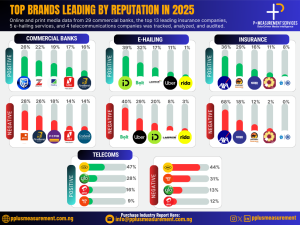
inDrive Nigeria led the sector with 39 per cent of positive reputation share, following extensive media coverage of its decision to reduce driver commission to 0.1 per cent during peak hours in Abuja. Bolt Nigeria followed with 32 per cent, supported by reports on its electric tricycle deployment in Lagos. LagRide recorded 17 per cent, driven by coverage of its electric vehicle infrastructure partnership, while Uber Nigeria accounted for 11 and Rida 1 per cent.
On the negative reputation scale, Bolt recorded the highest s per centhare at 40 per cent, linked to driver protests following fare reduction policies. Uber accounted for 29 per cent, inDrive 20 per cent, LagRide 8 per cent, and Rida 3 per cent, largely associated with reports on strike threats, platform reliability concerns, and driver earnings disputes.
The report notes that how platforms treat drivers has become as influential to reputation as rider experience.
Banking Industry: Profitability Confronted by Governance Risk
Among commercial banks, Stanbic IBTC recorded the strongest positive reputation position at 26 per cent, driven by recognition as KPMG’s top retail bank. Zenith Bank followed with 22 per cent, supported by dividend payout coverage. Fidelity Bank (19%), UBA (17%), and FirstBank (16%) gained positive reputation visibility through education initiatives, digital service upgrades, and branch automation projects.
However, reputational exposure remained significant. GTCO recorded the highest negative reputation share at 28 per cent, followed by FirstBank at 26 per cent, FCMB at 18 per cent, and both UBA and Ecobank at 14 per cent, mainly due to media reports concerning legal disputes, fraud investigations, and customer-related controversies.
The report highlights that in the banking sector, strong earnings and digital innovation strengthen reputation, but governance failures can rapidly undermine it.
Insurance Industry: Financial Stability and Data Protection Define Trust
In the insurance sector, AXA Mansard led positive reputation share with 36 per cent, followed by Leadway Assurance (29%), AIICO (16%), NEM Insurance (11%), and SanlamAllianz (8%).
AXA Mansard also accounted for the highest negative reputation exposure at 68 per cent, driven by reports of a significant decline in pre-tax profit. AIICO recorded 18 per cent, Leadway 12 per cent, and NEM 2 per cent, largely connected to regulatory matters and data protection concerns, including coverage of customer data breaches.
The findings indicate that insurers are now judged as much by financial resilience and cybersecurity posture as by product offerings.
Telecommunications Industry: Infrastructure Investment Meets Rising Public Expectations
MTN Nigeria led positive reputation share with 47 per cent, driven by infrastructure expansion narratives and innovation campaigns. Glo followed with 28 per cent, Airtel Nigeria with 16 per cent, and T2 (formerly 9mobile) with 9 per cent, largely supported by its rebranding coverage.
On the negative reputation side, MTN recorded 44 per cent, T2 31 per cent, Glo 13 per cent, and Airtel 12 per cent, influenced by reports on service quality challenges and the Nigeria Labour Congress boycott directive targeting telecommunications operators.
The sector’s results suggest that while capital investment enhances visibility, network reliability and customer experience increasingly determine long-term reputation.
Reputation Has Become a Strategic Business Asset
Across all four industries, the report finds a consistent pattern: reputation in 2025 closely followed corporate behaviour.
Brands that demonstrated transparency, operational fairness, financial discipline, digital reliability, and customer focus were more likely to build positive public trust. Companies facing labour unrest, legal disputes, regulatory sanctions, data breaches, or service disruptions saw these issues rapidly reflected in their reputation profile.
For brand owners, investors, regulators, and communication professionals, the implication is clear: reputation is no longer managed only through messaging, but through measurable actions that are permanently recorded in the media ecosystem and searchable online.
About P+ Measurement Services
P+ Measurement Services is Nigeria’s foremost independent media intelligence and reputation analytics consultancy and a member of the International Association for the Measurement and Evaluation of Communication (AMEC).
The firm provides media monitoring, reputation auditing, performance evaluation, and strategic communication and PR measurement services to corporations, public institutions, and communication consultancies across Africa.