


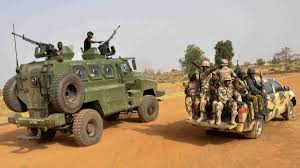

In the early hours of Friday, in the dusty border town of Damasak in northern Borno State, a routine military patrol turned into yet another grim reminder that Nigeria’s war against insurgency is far from over.
A major in the Nigerian Army, the commanding officer of the Damasak military base, was killed after fighters of the Islamic State West Africa Province (ISWAP) ambushed his patrol. The officer had been leading about 30 soldiers on foot, a task that has become a familiar, if dangerous, part of military operations in the region.
By daybreak, the patrol had scattered. Some soldiers found their way back to base. Others were missing. For hours, uncertainty hung over the town and within military circles as attempts to reach the commanding officer went unanswered, until confirmation emerged that he had been killed during the attack.
Damasak, the headquarters of Mobbar Local Government Area, sits close to Nigeria’s borders with Niger and Chad, a location that makes it both strategically important and persistently vulnerable. Over the years, insurgent groups have exploited the area’s porous borders, sparse population, and difficult terrain to regroup, move fighters, and launch attacks.
Although large-scale territorial control by insurgents has diminished, ISWAP has increasingly relied on ambushes, targeted strikes, and surprise attacks against military patrols and forward bases. The killing of a commanding officer in such circumstances highlights the evolving nature of the conflict: less about holding territory, more about attrition and psychological pressure.
Security sources say the patrol was attacked using a mix of explosives and gunfire, a tactic that has become a hallmark of ISWAP operations. The approach is designed to disorient troops, break formations, and limit the effectiveness of reinforcements.
In this case, the ambush forced the soldiers to disperse, complicating communication and immediate response. While some personnel later regrouped at the base, the loss of a senior officer underscores the risks soldiers continue to face during even routine movements.
The incident echoes previous attacks in the region. Only last year, a brigadier general was killed during an ambush on a military convoy along the Damboa–Wajiroko axis, reinforcing concerns about the vulnerability of patrols and convoys in contested areas.
The death of a commanding officer carries consequences beyond the immediate loss. Within the military, such incidents can affect morale, particularly among troops stationed in remote and high-risk zones. Commanding officers often serve as stabilising figures, coordinating operations and maintaining cohesion under difficult conditions.
For analysts, the attack also raises broader questions about:
- Intelligence gathering and early warning systems
- Adequacy of surveillance and reconnaissance support
- Protection of patrols operating outside fortified positions
While the military has recorded successes in degrading insurgent leadership and reclaiming territory, attacks like this suggest that ISWAP retains the ability to exploit gaps and strike opportunistically.
For residents of Damasak and surrounding communities, the ambush reinforces a familiar reality: insecurity remains close at hand. Continued attacks discourage resettlement, disrupt economic activity, and strain relations between civilians and security forces, even as cooperation remains critical to intelligence gathering.
Local sources say fear often spikes after such incidents, with civilians worried about possible reprisals or renewed insurgent activity in the aftermath of military losses.
Despite repeated assurances by authorities that insurgent capacity has been significantly weakened, the killing of an army major during a routine patrol serves as a stark reminder that the conflict in the North-East is far from resolved.
ISWAP’s ability to launch coordinated ambushes points to a group that, while pressured, remains adaptive and dangerous. For Nigeria, the incident underscores the need for sustained focus on intelligence-led operations, force protection, and regional cooperation, particularly along border communities like Damasak.
As the nation awaits official confirmation and further details from the military, the death of the commanding officer stands as a sobering reminder of the human cost of a conflict now well into its second decade.
It is a reminder that behind statistics and security briefings are soldiers navigating hostile terrain, communities living with uncertainty, and a country still searching for a lasting end to an insurgency that refuses to fade quietly.
