


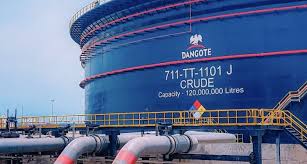
Maritime experts say the Dangote Petroleum Refinery has the capacity to unlock thousands of sea-based jobs across Nigeria’s shipping, port operations and marine services sectors, if the country prioritises marine transportation for refined petroleum products and boosts indigenous vessel participation.

They noted that the refinery, which recorded more than 600 vessel calls in its first year of operation, has already emerged as a major driver of maritime activity, opening up opportunities in coastal shipping, crewing, vessel ownership, inspections, port services and marine logistics.
Captain Tajudeen Alao, National President of the Nigerian Association of Master Mariners (NAMM), described the refinery as a strategic national asset with the potential to transform Nigeria’s maritime economy.
“The Dangote Refinery is a major driver of wealth creation. Its location on the open sea gives Nigeria a strategic advantage for exports and maritime trade,” Alao said.
He explained that the refinery’s deep-water access allows vessels to berth easily for both local distribution and international exports, while also supporting coastal shuttle services to ports such as Lagos, Port Harcourt, Warri and Calabar.
According to Alao, prioritising the evacuation of refined products by sea rather than by road would significantly expand employment across the maritime value chain.
“If we focus on marine transportation, it will create jobs in vessel ownership, crewing, port operations and support services,” he said, adding that Nigeria’s extensive tank farm network makes sea transport safer and more efficient than road haulage.
He stressed that the scale of operations at the refinery presents a major opportunity for increased indigenous participation, urging policymakers to enforce existing maritime laws and encourage banks to provide job-focused funding to local operators.
Alao noted that a single 5,000-tonne tanker can move the equivalent of about 150 trucks, each carrying roughly 30 tonnes, and can be loaded within 12 to 18 hours, far more efficiently than road transport, which often causes congestion and infrastructure damage.
Beyond cargo movement, he said the refinery would sustain professional maritime services, including tanker vetting, ship inspections and compliance checks, creating jobs for Nigerian mariners, surveyors and inspectors while supporting certification and skills development.
On local content, Alao said Nigeria already has strong legal frameworks such as cabotage regulations that support indigenous participation, adding that stricter enforcement would help retain revenue within the country.
“Nigerian-owned and operated vessels will keep taxable income in Nigeria and prevent revenue losses linked to foreign vessels carrying Nigerian cargo,” he said.
Similarly, Capt. (Dr) Michael Ifesemen, master mariner and maritime expert, said the refinery has already increased marine activity, with a direct impact on job creation.
“The influx of vessels has expanded demand for marine services and manpower, creating jobs for Nigerians in port operations and other maritime-related activities,” he said.
Ifesemen acknowledged the current dominance of foreign vessels but said it presents an opportunity for Nigerian ship owners to upgrade their fleets and meet international standards.
He added that the refinery would strengthen West African coastal shipping, deepen Nigeria’s role in regional maritime trade and enhance the country’s cabotage regime.
According to him, evacuating refined products by sea would also reduce pressure on Nigeria’s road infrastructure and cut government spending on repairs caused by heavy-duty trucks.
“Coastal transhipment along the West African corridor will require barges, many of which can be built locally. This will create additional jobs for Nigerian barge builders and operators,” he said.
On the long-term outlook, Ifesemen said the refinery would attract more cargo flows, revive activity at underutilised ports, and support sustained employment growth across the maritime sector.
He added that exporting refined petroleum products offers higher value than exporting crude oil, urging Nigeria to fully maximise the refinery’s maritime and economic potential.

