


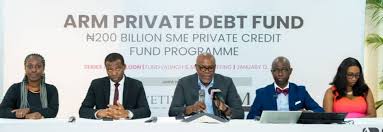
ARM Investment Managers has launched a ₦200 billion Private Debt Fund aimed at easing Nigeria’s SME financing gap by providing long-term credit at rates below prevailing market levels.

The fund, which debuts with a ₦25 billion Series 1, is designed to channel non-bank financing to scalable small and medium-sized enterprises (SMEs) that struggle to access affordable loans from commercial banks.
Speaking at the unveiling in Lagos on Monday, Deji Opeola, Fund Manager, said the ARM Private Debt Fund would offer longer-tenor loans, typically three to five years, priced annually and structured around borrowers’ cash-flow realities.
The fund is being raised at the Federal Government’s 10-year bond yield plus 300 basis points, a cost of capital below Nigeria’s current policy rate of about 27 per cent. Wale Odutola, ARM Group CEO, said the programme would be scaled cautiously to ₦200 billion, with new series launched only as quality lending opportunities emerge.
“Our goal is not to raise money and park it in treasury bills,” Odutola said. “We want disciplined deployment that allows SMEs to borrow at rates lower than what is available in the banking system or informal markets.”
ARM noted that many Nigerian SMEs currently borrow at 4-5 per cent per month due to limited access to formal credit. By contrast, the fund targets pricing closer to 20 per cent per annum, which Opeola said could significantly improve business margins and long-term viability.
Loans will be company-specific and risk-based, using S&P Global’s credit-rating framework, with a single-obligor limit of ₦5 billion to ensure diversification. In addition to funding, ARM said it would support borrowers in strengthening governance, financial reporting and strategic planning.
The fund will focus on SMEs in manufacturing, trade, services, technology and agro-processing, while excluding primary agriculture due to higher risk. It is structured as a multi-currency programme, with naira loans for Nigerian firms and a parallel dollar fund targeting SMEs across sub-Saharan Africa, excluding South Africa.
ARM said lending currency would be strictly matched to borrower cash flows to avoid foreign-exchange risk, underscoring its emphasis on sustainability over rapid expansion.

