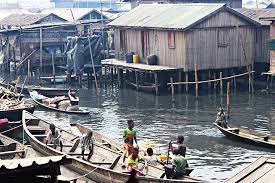
The Lagos State Government is desperately resorting to media PR and damage control following public outrage as a result of the ongoing onslaught on the Makoko community.
The initial agreement held by the Lagos State Ministry of Urban Development and the community was to pull down housing structures within 30 30-metre corridor from the power lines. When the chiefs ran to Alausa yesterday to report that the demolition squad was razing down houses beyond their agreement, the ministry’s reps said they would go ahead with 50 metres. They agreed and returned.
Lagos State officials have gone to town with the LIE that the chiefs agreed to 100 metres. And it may all sound like figures, but the fact is that’s 70 extra metres into the community housing hundreds of families and implies that thousands of people would be displaced without alternative shelter. Already, hundreds are displaced, with many sleeping inside boats and dug-out canoes. The demolition work is ongoing as we speak.
Worse still, Lagos State is directly contravening official regulations which stipulate 30 30-metre distance or at most 50 metres. It is all part of the grand plan acted out by the Ministry of Urban Development and Lagos State Building Control Agency (LASBCA).
In less than a year, the government, working with private developers, some greedy traditional rulers and land grabbers using armed personnel and armed thugs, razing down communities most times with absolutely no notice. Several of the affected community members, mostly children and elderly persons, have died in the process.
Some of the communities affected in last year’s wave of demolition include Oko-Baba, Ayetoro in Makoko, followed by those of Otumara and Baba-Ijora, then the recent massive eviction of Oworonshoki and Precious Seeds communities, all of which led to the displacement of tens of thousands of economically vulnerable Lagosians. Not to mention Monkey Village (where we lost our youth ICT centre) or Ifelodun, which they attempted to demolish during the COVID-19 lockdown, or Ilaje-Bariga, Otodo-Gbame, and so many others over the years, leading to the displacement of tens of thousands of people and including several deaths.
Hundreds of houses demolished over time were either never given the mandatory notice, as in Monkey Village or in gross violation of court process, eg Oworonshoki and currently that of Makoko, whose case is in court. As far as the Lagos State Government is concerned, human and housing rights shouldn’t exist in the realms of the poor, the majority of whom constitute the ‘megacity’s population.
People at the highest level of government are seizing lands belonging to the poor so that they can, in cahoots with private developers, build private exotic structures; that’s just what it is. They are driving the poor as far away from the city centre as possible, even though the economy is dominated and powered/serviced by the informal sector.
The poor do not fit into their urbanisation agenda; there is no construction of affordable/low-cost or social housing to mitigate the acute housing crisis, yet their votes are always suitably harvested for electoral wins every four years.
Supposing the government decides to take a piece of land it deems or claims is suitable for a better or official use, there are laid down rules involving prior informed consent, takeover notice, relocation and compensation, rules which the state government violates consistently. These are internationally laid down principles, but no, here it’s the rule of force.
As I write, there is ongoing pandemonium in Makoko with the demolition squad tear-gassing residents and generally terrorising them. Absolute chaos.
For many across the world, it’s a Happy New Year, but for thousands of people in Makoko, West Africa’s most populated informal community, it’s a tepid and traumatised entry into the unknown.
Betty Abah