

By Elivs Eromosele

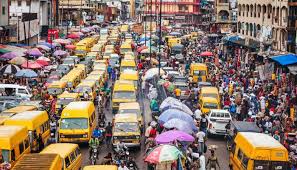
When Lagosians say they spend half their lives trapped in traffic, it is not an exaggeration. Now, the 2025 Mid-Year Traffic Index by City Report confirms this reality: Lagos is the world’s most congested city, listed ahead of Los Angeles, Delhi, and San Jose.
With a staggering traffic index of 365.9, the Nigerian megacity has officially ascended to the height of being the world’s capital of traffic congestion. Numbeo reports that commuters spend an average of 70 minutes per trip, which means Lagosians spend more than two hours daily stuck in traffic.
The real question to ask at this point is: why does Lagos, a city of bountiful commerce and culture, also lead the world in traffic stress?
Lagos is today home to over 20 million inhabitants, easily placing it among the fastest-growing cities in the world. Every day, thousands of individuals flood into the city to seek opportunity. The exponential growth has not been met with a corresponding rise in road and transport infrastructure.
Instead, the city remains highly dependent on its transport system, much of which was conceived decades ago to cater for a much smaller population. As the number of cars increases, the bottlenecks deepen.
One major factor driving congestion is the excessive use of private cars and commercial minivans (danfos) across the city. Public transport alternatives are insufficient, concentrated in a few corridors and not yet fully developed.
This systemic overreliance on road transport explains why Lagos also recorded the highest inefficiency index (491.7) among the world’s top ten congested cities.
Traffic congestion is more than just a personal irritation; it’s a drain on productivity and the environment.
Naturally, it leads to productivity loss. There is no surprise here. With workers spending hours a day commuting, businesses lose man-hours. It is not unusual for meetings to start late because participants are “stuck in traffic.”
In addition, traffic jams precipitate environmental load. This is why Lagos tops the CO₂ emission list of jammed cities with 9,330.8 grams of CO₂ per commuter for a round-trip drive. The choking fumes from countless generators and idling cars worsen the city’s already poor air quality.
The irony is a costly one: the more Lagosians try to drive themselves out of traffic, the deeper into it the city steers.
Interestingly, Lagos ranks above traffic-prone cities such as Los Angeles (3rd place, with a 56.8-minute average commute) and Delhi (6th, with 57.8 minutes). The difference is in scale and system.
While Los Angeles struggles with car dependency, it still boasts a sprawling freeway system and alternative modes like subways and cycling networks. Delhi, too, has invested heavily in its metro system, moving millions daily. Lagos, by contrast, is still playing catch-up.
Hope permeates even amidst the grim statistics. There are signs of progress. The Lagos Rail Mass Transit system is gradually transforming the city’s commuting culture.
The Blue Line, launched in 2023, covers a 13-kilometre stretch from Marina to Mile 2, already moving over 5 million passengers. Work is underway to extend it by another 14 kilometres to Okokomaiko by 2026.
The Red Line, commissioned in 2024, is 37 kilometres long, with the first 27 kilometres from Agbado to Oyingbo bridging major urban corridors.
These projects mark Lagos’s most ambitious push yet to break the city’s reliance on roads.
At the heart of Lagos’s traffic crisis lies a perfect storm of population growth, weak planning, inadequate alternatives, and a car-centred culture. Each factor feeds into the other, creating the bottleneck that defines daily life in the city.
The truth is that until rail, water transport, and smarter road management systems become fully operational and widely accessible, Lagos will remain a world leader in congestion, not the kind of global ranking the city desires.
If Lagos is to relinquish its position as the world’s most congested city, it must do three things: a. will have to increase investments in multi-modal transportation, b. strengthen enforcement of traffic rules more frequently, and c. implement smart city technologies for traffic management.
For now, Lagosians continue to live with a grim irony: in Africa’s most dynamic city, movement remains painfully slow.
Elvis Eromosele, a corporate communications professional and sustainability advocate, wrote via elviseroms@gmail.com.
