
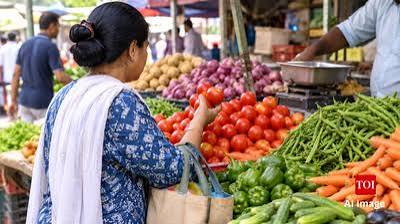
India is facing renewed inflationary pressure, with food prices rising sharply and putting additional strain on household budgets, particularly among low-income families.
Government data show that India’s retail inflation climbed to 6.09 per cent in October 2026, up from 5.54 per cent in September. Food inflation rose even faster, reaching 8.94 per cent, highlighting the growing cost of feeding households.

The pressure was more pronounced in rural areas, where food inflation stood at 9.09 per cent, compared with 8.68 per cent in urban centres.
Economists attribute the increase to a combination of erratic weather, supply disruptions, shortages of key agricultural commodities and rising production costs.
India’s heavy dependence on rainfall makes its agricultural sector particularly vulnerable to changing weather patterns. Nearly 60 per cent of the country’s farmland relies on rain, while the southwest monsoon this year was 13 per cent below normal and unevenly distributed. The intensifying effects of El Niño have also raised concerns about agricultural output.
Although food now accounts for a smaller proportion of Indian household expenditure than in previous years, it remains a major driver of inflation.
Food and beverages represent 36.75 per cent of India’s latest Consumer Price Index basket, down from 45.86 per cent under the previous measurement series. The decline reflects changing consumption patterns, with households allocating more spending to transport, healthcare, education and other services.
However, rising food prices remain particularly damaging to poorer households, which have limited room to adjust their spending.
According to calculations by Dharmakirti Joshi, chief economist at analytics firm Crisil, the poorest 20 per cent of rural households experienced inflation of 6.9 per cent in October, compared with 6.5 per cent for the richest 20 per cent.
In urban areas, inflation for the poorest households reached 6.1 per cent, against 5.3 per cent for the wealthiest.
The rising cost of everyday meals illustrates the pressure.
Crisil’s Roti Rice Rate analysis found that the cost of preparing a home-cooked vegetarian thali increased by 12 per cent year-on-year in October. A non-vegetarian meal rose by nine per cent. Higher prices of onions, tomatoes, vegetables, edible oil, rice and cooking gas contributed to the increases.
Rice prices rose by approximately 10 per cent year-on-year, pulses by eight per cent, edible oil by 13 per cent and liquefied petroleum gas (LPG) by 10 per cent.
Pushan Sharma, director of intelligence at Crisil, said the price increases were becoming broad-based rather than being driven by a handful of commodities.
The distinction is important because households may reduce their consumption of certain vegetables when prices rise, but have fewer alternatives when the cost of staples such as rice, pulses and cooking oil increases.
Beyond weather disruptions and rising farm input costs, weaknesses in India’s agricultural supply chain are contributing to food inflation.
Onions and tomatoes, for instance, are particularly vulnerable to seasonal price fluctuations.
India’s winter onion harvest, known as the rabi crop, accounts for roughly two-thirds of total production. Harvested around March and April, the crop is stored for several months. As stocks decline before the next harvest, prices can rise sharply. Tomato prices also fluctuate, particularly during periods of extreme heat or reduced market supply.
Economists say inadequate infrastructure for sorting, grading, storage and processing makes these fluctuations worse. During periods of excess production, farmers sometimes struggle to sell perishable produce at profitable prices. Yet months later, consumers may face steep price increases as supplies tighten.
Better storage and food processing facilities could help address this imbalance. For instance, surplus tomatoes could be processed into puree and other products, reducing waste while extending their availability beyond the harvest season.
Energy costs are another source of pressure. Higher fuel prices increase transportation and irrigation expenses, while fertiliser costs affect farm production. India’s dependence on imported edible oils also exposes domestic food prices to movements in international markets.
India has measures to cushion households against rising food prices.
Government cereal reserves remain comfortably above prescribed minimum requirements, while a free-food programme covering nearly 800 million people provides support to vulnerable households.
The country’s substantial rice stocks also offer some protection against supply shortages.
However, economists warn that prolonged food inflation could eventually spread across the wider economy.