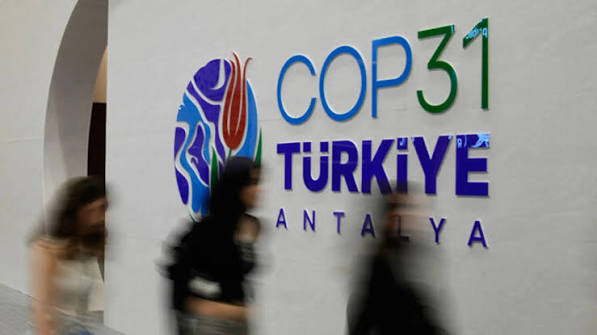
The longest United Nations climate conference in history has ended without a major agreement, exposing deep divisions among countries over fossil fuels and financial support for nations most vulnerable to climate change. The COP31 negotiations, hosted in Antalya, Turkey, were scheduled to conclude on Friday but stretched into Sunday as delegates struggled to reach a consensus on key issues.

However, the final agreement failed to satisfy the European Union, Pacific island nations and several other countries because it made no direct reference to fossil fuels, widely recognised as the principal driver of global warming. Developing countries were equally disappointed by the absence of specific financial commitments from wealthier nations to help them adapt to rising temperatures and increasingly severe climate impacts.
The breakdown marks the first time since the controversial 2009 Copenhagen climate summit that a major political agreement at a COP conference has failed to materialise.
António Guterres, UN Secretary-General, expressed deep disappointment over the outcome, accusing powerful fossil fuel interests of undermining efforts to tackle climate change.
He alleged that these interests were adopting tactics similar to those previously used by the tobacco industry to undermine scientific evidence and delay policy action. “They are distorting the science, delaying policy, blocking action, and piling up huge profits while people everywhere pay the price,” Guterres said.
Anthony Albanese, Australian Prime Minister, whose country co-hosted the negotiations, attributed the failure to the difficult geopolitical environment. “That is the reality,” he said on Monday.
After two weeks of negotiations, exhausted delegates received a fresh draft agreement in the early hours of Sunday in a final attempt to resolve the deadlock. However, the document contained no direct mention of fossil fuels. Its only indirect reference to coal, oil and gas was an acknowledgement of the agreement reached at COP28 in 2023, which called for a transition away from fossil fuels in energy systems.
The omission triggered strong objections from the European Union.
Darragh O’Brien, Ireland’s Minister, representing the EU, said the proposed decisions fell far short of the ambition required to address the climate crisis. “It is unconscionable that we would have a climate pact that makes no mention of fossil fuels,” he said.
Panama, the Marshall Islands and other countries also criticised the agreement, arguing that it failed to respond adequately to the urgency of the climate crisis. Interestingly, an earlier draft had mentioned fossil fuels six times, but the references were subsequently removed following objections from oil-producing countries.
Mohammad Ayoub, Saudi Arabia’s representative, defended the position of Arab countries, arguing that they had engaged in the negotiations in good faith and accounted for only a relatively small share of historical greenhouse gas emissions.
Russia also cautioned against what it described as an excessive focus on fossil-fuel slogans, warning that a rapid transition away from them could worsen energy poverty. Former US Vice-President and climate campaigner Al Gore condemned the outcome, describing it as outrageous that a handful of oil-producing countries could prevent any mention of fossil fuels in a global climate agreement.
He also called for significant reforms to the COP process, arguing that the negotiating framework should better reflect the scientific evidence and the position of the majority of participating countries.
Beyond fossil fuels, climate finance emerged as another major source of disagreement. Developing countries have consistently argued that wealthier nations, whose industrialisation contributed significantly to historical greenhouse gas emissions, must provide adequate funding to help vulnerable economies cope with climate change.
At COP30 in Brazil last year, countries agreed to triple adaptation finance. However, the latest draft agreement contained neither specific financial figures nor a clear baseline for measuring progress towards that commitment.
This raised concerns among developing countries that the absence of measurable targets would allow wealthier nations to avoid meaningful financial obligations. Mohamed Adow of Power Shift Africa, an African climate and energy think tank, criticised the failure to provide concrete commitments. “Rich nations and polluting governments cannot keep arriving empty-handed,” he said.
Miatta Fahnbulleh, UK’s Energy Secretary, described the failure to reach a political agreement as immensely disappointing but maintained that her country’s commitment to tackling climate change remained unwavering.
The breakdown comes at a particularly critical moment for global climate action. The 2015 Paris Agreement, signed by nearly 200 countries, established the ambition of limiting global warming to well below 2°C, while pursuing efforts to restrict the increase to 1.5°C above pre-industrial levels.
However, the world is now on course to exceed the 1.5°C threshold in the coming years, raising concerns about the long-term consequences for ecosystems, economies and vulnerable populations. According to the United Nations, current government policies put the world on a trajectory towards approximately 2.8°C of warming by 2100.
Although this represents an improvement on earlier projections, it remains significantly above the Paris Agreement’s targets. Returning temperatures to 1.5°C after an overshoot would require an unprecedented expansion of carbon removal technologies, many of which are not yet available at the scale required.
The stakes are particularly high as extreme weather events intensify across different regions, with heatwaves, droughts and flooding increasingly disrupting communities and economic activities.