
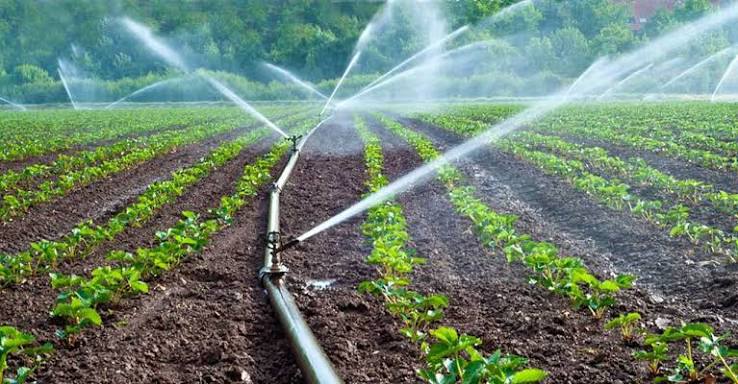
The Federal Government has signed an agreement with US-based Valmont Industries, Inc. to establish an irrigation equipment manufacturing plant in Nigeria, in a move aimed at boosting local production, transferring technology and reducing dependence on imported agricultural equipment.

The agreement, disclosed on Saturday by Muhammed Dahiru, Chairman of the Presidential Implementation Committee on Technology Transfer (PICTT), will see Valmont collaborate with the National Agency for Science and Engineering Infrastructure (NASENI) to develop local manufacturing capabilities.
Dahiru described the partnership as a major step towards transforming Nigeria’s agricultural sector, noting that it would bring a leading global manufacturer of mechanised irrigation systems into the government’s flagship Irrigate Nigeria Programme.
Valmont, through its Valley Irrigation brand, specialises in centre-pivot irrigation technology, which uses rotating sprinkler systems to distribute water across farmland.
According to Dahiru, Valley Irrigation accounts for more than 40 per cent of centre-pivot systems worldwide, with over 250,000 pivots deployed across more than 120 countries and approximately 12 million hectares under irrigation.
The company also operates more than 146,000 connected irrigation devices globally, highlighting its experience in technology-driven water management.
Beyond establishing the proposed manufacturing plant, the agreement provides for a 40,000-hectare pilot irrigation programme in Adamawa State.
The project will be implemented in collaboration with the Nigeria Incentive-Based Risk Sharing System for Agricultural Lending (NIRSAL) and the National Agricultural Development Fund (NADF).
Under the arrangement, PICTT will coordinate implementation, while NASENI will lead efforts to facilitate technology adoption and domestication.
The initiative is expected to support the transfer of technical and manufacturing expertise, expand access to mechanised irrigation and strengthen Nigeria’s capacity to produce agricultural equipment locally.
Dahiru also disclosed that the committee was exploring a possible partnership with the University of Nebraska and the Robert B. Daugherty Water for Food Global Institute to advance sustainable irrigation practices and improve water resource management.
The proposed collaborations are expected to contribute to the expansion of irrigation infrastructure, promote year-round farming and strengthen agricultural productivity.
However, the government has yet to disclose the proposed factory’s investment value, production capacity or expected completion date.
The agreement comes as Nigeria continues to grapple with limited irrigation infrastructure, leaving much of its agricultural production dependent on seasonal rainfall.
In September 2026, reports indicated that only 5.8 per cent of Nigeria’s agricultural land had been irrigated under command-area development, underscoring the country’s significant irrigation deficit.
The figure was disclosed by Vishwajit Sinha, Chief Executive Officer of Greenview Fertiliser Corporation, at the FirstBank Agric & Export Expo 2026 in Lagos.
The Federal Government has also been pursuing other initiatives to expand irrigation infrastructure and improve water management.
In March 2026, the government and the World Bank inaugurated the $500 million Sustainable Power and Irrigation for Nigeria (SPIN) Project. The initiative is designed to modernise irrigation infrastructure, improve dam safety and strengthen water resource management.
The project targets 500,000 hectares of irrigated agriculture, building on earlier interventions under the Transforming Irrigation Management in Nigeria (TRIMING) programme.
Similarly, in March 2025, NASENI launched the first phase of its Irrigate Nigeria Project in Gamawa Local Government Area of Bauchi State. The initiative introduced a model through which participating farmers repay government support with portions of their harvests.
The programme is designed to promote year-round farming, improve farmers’ incomes and strengthen food security through mechanised irrigation and agricultural inputs.
The proposed Valmont factory and Adamawa pilot represent another effort to address Nigeria’s irrigation challenges, with a stronger emphasis on technology transfer, local manufacturing and reducing dependence on imported equipment.