


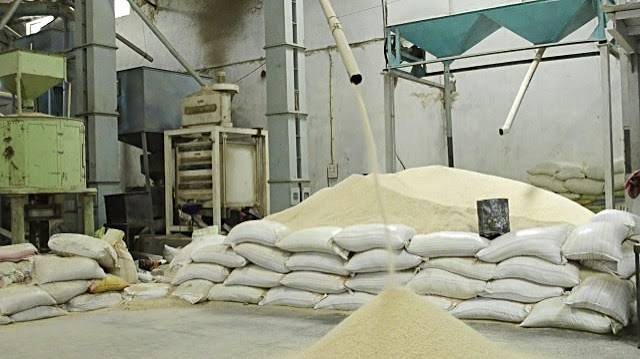
The Economic Community of West African States (ECOWAS) has launched a $650 million Resilient Rice Value Chain Development Project (REWARD) as part of efforts to achieve regional rice self-sufficiency and reduce dependence on food imports.

The initiative is designed to strengthen rice production, improve processing and marketing, and make locally produced rice more competitive across West Africa. The launch was accompanied by the inauguration of a regional steering committee responsible for providing strategic oversight and coordinating the programme’s implementation under the 2025–2035 Regional Rice Roadmap.
ECOWAS estimates that the region will require approximately $25.6 billion in investments to achieve its target of producing 35 million tonnes of rice annually by 2035. The project is backed by the African Development Bank (AfDB), with technical support from the Africa Rice Centre (AfricaRice).
Speaking at the launch, Anthony Ogunjimi, the ECOWAS Commission’s Vice President, said the initiative followed a mandate from the region’s heads of state to mobilise funding and strengthen food security across member countries.
Ogunjimi, who was represented by the Commission’s Commissioner for Economic Affairs and Agriculture, Dephue Zuo Dephue, said the regional leadership had tasked the Commission with ensuring greater food availability and self-sufficiency. “Our heads of state of ECOWAS gave the ECOWAS Commission a mandate to raise funding to ensure availability and food sufficiency for the subregion,” he said.
He disclosed that the overall investment requirement for the regional rice development agenda stood at approximately $25.6 billion.
According to him, an investment roundtable held in Accra generated about $1.5 billion in commitments, expressions of interest and ongoing financing discussions. “From the financing conference we had in Accra, we were able to raise 1.5 billion dollars, which is going to be used for the time being to ensure that we have access to financing for farmers, for business value chain, for production in the subregion,” he said.
He called on governments, private investors, businesses and individuals across West Africa to support the initiative.
Dephue said achieving food sovereignty would depend on the region’s ability to produce more of the food it consumes and reduce its exposure to external supply disruptions.
He, however, cautioned that increasing rice production alone would not guarantee self-sufficiency without simultaneous improvements in fertiliser supply, irrigation, quality agricultural inputs, processing infrastructure, financing and market access.
“West Africa’s food sovereignty depends on our ability to produce more of the food we consume and reduce our vulnerability to external shocks,” he said.
He explained that the Regional Rice Roadmap 2025–2035 builds on the 2004 Yamoussoukro Declaration and provides a framework for coordinating investments and reforms across the rice value chain.
Under the programme, ECOWAS will support regional policy and regulatory reforms, improve agricultural input regulation, strengthen coordination and deploy digital monitoring through the ECOWAS Rice Observatory.
The newly inaugurated steering committee will provide strategic direction, facilitate decision-making and identify implementation bottlenecks to ensure accountability and effective delivery.
Dephue said the ultimate measure of success would be improved production systems, expanded processing capacity, more competitive locally produced rice, increased investment and better livelihoods for farmers.

