


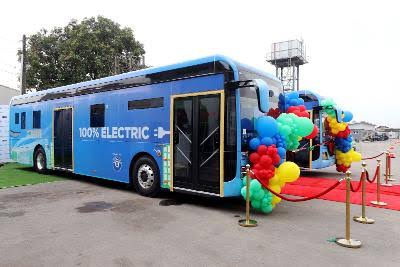
Lagos State has received 11 new electric buses from Oando Clean Energy Limited as part of a partnership with the Lagos Metropolitan Area Transport Authority (LAMATA) to deploy 552 fully electric vehicles across the state’s public transportation network.

The delivery represents the first batch of an additional 50 electric buses planned for Lagos, with 39 more expected to arrive as the programme progresses.
Hadiza Adukonu, Vice President, Opportunity, Maturation and New Ventures at Oando Clean Energy, disclosed this in a video shared by LAMATA on its X account announcing the arrival of the buses.
The latest delivery brings the total number of electric buses supplied by Oando under the partnership to 13, including two units introduced in May 2023.
Speaking on the development, Adukonu said the partnership with LAMATA had demonstrated the operational viability of electric buses in Lagos since the first two vehicles were deployed in May 2023.
She noted that the initial buses had recorded minimal downtime over three years, strengthening confidence in the expansion of electric public transportation in the state.
“OCEL’s plan is to ramp this up from the two buses that we have, through the initial deployment of an additional 50 buses. Right now, we are launching the first set of 11 buses, and then we’ll ramp up by adding on an additional 39 buses. Ultimately, heading to 552 100 per cent electric buses in Lagos State,” she said.
Oando Clean Energy and LAMATA signed a Memorandum of Understanding in 2022 to promote sustainable transportation and accelerate the adoption of cleaner mobility solutions across Lagos.
The new buses, manufactured by China’s Yutong, can accommodate 39 seated and 40 standing passengers.
They come equipped with air conditioning, Wi-Fi, 360-degree cameras and additional security cameras. The vehicles also feature wheelchair accessibility and priority seating for elderly passengers.
Providing an update on the performance of the first two electric buses deployed in 2023, Adukonu disclosed that they had transported approximately 788,000 passengers and covered 433,000 kilometres between May 2023 and the latest reporting period.
She said the buses had also helped avoid the consumption of approximately 216,000 litres of diesel.
Over the same period, the vehicles consumed 584,000 kilowatt-hours of electricity and recovered an additional 192,000 kilowatt-hours through regenerative braking technology.
The regenerative system captures energy generated during braking and feeds it back into the vehicles’ power systems, improving overall energy efficiency.
According to Adukonu, expanding the electric bus fleet would help reduce transport-related emissions, improve air quality and deliver potential public health benefits for Lagos residents.
LAMATA said the new delivery advances its plan to introduce an initial 50 zero-emission vehicles into the state’s public transportation network, with a longer-term target of 552 electric buses.
The expansion is also expected to reduce greenhouse gas emissions, noise pollution and dependence on conventional transport fuels.
The deployment comes as LAMATA implements a policy to progressively phase out diesel-powered buses from Lagos’ regulated public transportation system.
Under the policy, which took effect in January 2026, operators introducing new buses are required to adopt compressed natural gas (CNG) or electric-powered vehicles.
LAMATA’s Managing Director and Chief Executive Officer, Engr. Mrs Abimbola Akinajo, said existing diesel buses would also be progressively replaced with cleaner alternatives.
She explained that the policy supports Lagos State’s ambition to achieve net-zero emissions by 2050, with transportation identified as a significant source of greenhouse gas emissions.
The initiative also aligns with the Lagos State Transport Policy, which targets having 52 per cent of BRT buses powered by clean energy by 2050.

