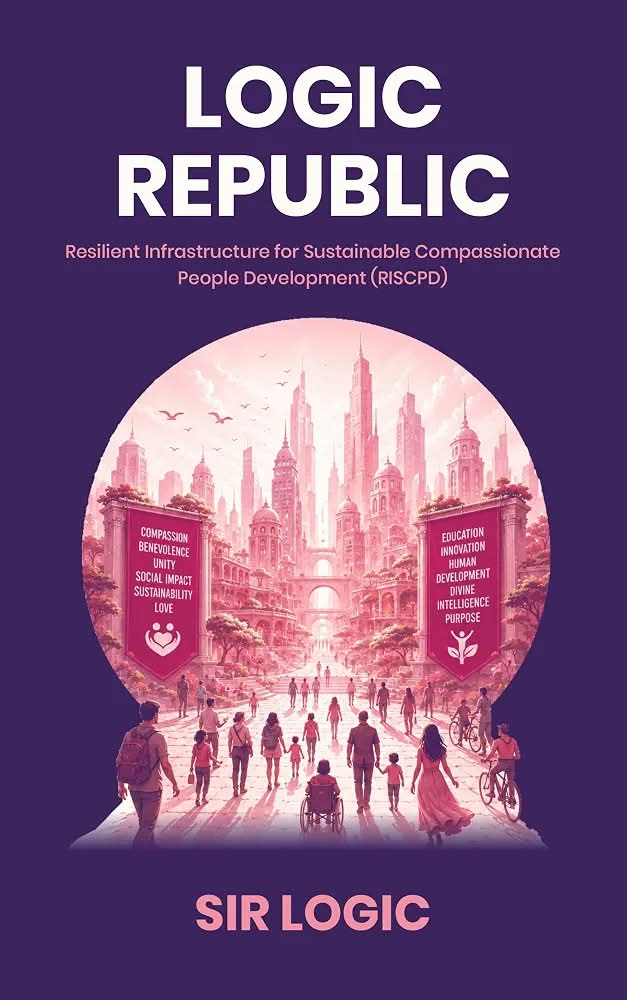
In a world grappling with inequality, poor leadership, economic dislocation and declining social cohesion, Sir Logic proposes a radical rethink of how societies organise themselves. His 189-page book is an ambitious attempt to place compassion, balance and the greater common good at the centre of human development.

What if poverty is not primarily about money? What if leadership failure is as much a reflection of society as it is of those elected to govern? And what if humanity’s much-celebrated civilisation is yet to attain its true meaning?
These are some of the provocative questions raised in Logic Republic, a philosophical and transformational work by Sir Logic, born Prince Caleb Agboji, and published by Prima, an imprint of Narrative Landscape Press Limited.
In 189 pages, the author attempts something considerably more ambitious than offering another critique of dysfunctional institutions or prescribing familiar solutions to development challenges. He seeks to reimagine the fundamental systems governing human existence, from economics and politics to education, technology, relationships and the meaning of life.
His proposed alternative is the Logic Republic, built around what he calls Resilient Infrastructure for Sustainable Compassionate People Development (RISCPD). Its central organising principle is the Greater Common Good (GCG), an approach that places collective human advancement above narrow individual interests.
The proposition is that humanity’s problems are not necessarily rooted in a shortage of resources but in a deficit of understanding, wisdom, balance and purposeful leadership.
In the book, Sir Logic divides the human experience into two broad conditions: the Confused Republic and the Logic Republic. The former describes the present state of humanity, characterised by confusion, corruption, commotion, competition, greed and disconnection from purpose. The latter represents an aspirational society organised around compassion, benevolence, unity, discipline, sustainability and shared prosperity.
It is an interesting framework, particularly when viewed against Nigeria’s development experience. A country endowed with substantial human and natural resources continues to struggle with poverty, institutional weakness, insecurity and governance failures.
For the author, these challenges cannot be resolved by changing political officeholders alone. The problem is deeper, extending to the values, behaviours and patterns that society reproduces.
His argument about leadership is particularly striking. Leadership, he insists, is not a position acquired through election or appointment. It is an inherent human responsibility, beginning with the ability to govern oneself and influence others positively.
This challenges the familiar tendency to blame political leaders for every national failure while overlooking the societal attitudes and practices that help reproduce poor leadership. It is an uncomfortable but worthwhile argument: a society cannot sustainably produce a different kind of leadership without confronting the behaviours and values that shape its institutions.
One of the book’s more provocative contributions is its attempt to redefine poverty. Rather than treating poverty primarily as the absence of financial resources, Sir Logic describes it as a broader state of helplessness arising from deficits in understanding, wisdom, balance and leadership.
This departs from conventional development thinking, which measures poverty through income, consumption and access to essential services. The author’s contention is that such measures, while useful, do not adequately capture the underlying human and institutional weaknesses that perpetuate deprivation.
Nigeria provides an obvious context for examining this argument. Resource abundance has not translated into broad-based prosperity, suggesting that the challenge extends beyond the availability of economic assets to how they are managed and distributed.
However, redefining poverty is only the first step. The real test is whether the proposed framework can produce measurable indicators and practical interventions capable of improving people’s lives.
Central to this framework is Balance Quotient (BQ), which the author presents as an integrating measure of human awareness and judgement. Moving beyond familiar concepts such as Intelligence Quotient (IQ) and Emotional Quotient (EQ), he argues that balance is essential to navigating life’s complexities.
The book’s economic propositions are equally ambitious. Concerned about the limitations of conventional capitalism, Sir Logic introduces what he calls Lucrativism, or compassionate lucrativism. The underlying proposition is that profitability should not exist independently of human welfare. Businesses and economic institutions should create value while deliberately addressing societal needs.
This thinking finds expression in his advocacy of impact-driven institutions, a socially responsive economic system and mechanisms that empower those who genuinely need support rather than simply rewarding those who already possess influence and privilege.
His proposed government framework, Manocracy, similarly seeks to address what he considers the shortcomings of democracy without necessarily discarding it. It is presented as a complementary system intended to strengthen governance and improve leadership accountability.
These proposals raise important questions about institutional design, the distribution of power, individual freedoms and implementation. The author establishes an interesting direction, but the practical architecture of these systems requires further elaboration.
One of the most relatable discussions in Logic Republic concerns pattern recognition. Sir Logic argues that individuals, families and nations frequently remain trapped in recurring cycles because they fail to identify the patterns responsible for their difficulties. From abandoned personal projects and unsuccessful relationships to repeated political and economic failures, the author sees a common thread: the inability to recognise and deliberately change destructive patterns.
His proposition is memorable: a pattern can only be changed by creating another pattern capable of replacing it.
For Nigeria, this is particularly relevant. Changing political officeholders without changing the institutional incentives, behaviours and practices that sustain poor governance may simply produce different actors performing familiar roles. The country does not merely need new leaders; it needs a different pattern of leadership and governance.
Now, the ideas presented in Logic Republic are part of a much broader intellectual undertaking. Sir Logic describes himself as the originator of several theories, laws, principles and conceptual frameworks developed in his pursuit of a unified understanding of life and the universe.
His body of work includes the Theory of Life, Law of Sustainable Life, Creation and Production, COAMSD Formula, Law of Undetected Motion, Principle of Greater Common Good, Law of Pairability of Energy, Manocracy, Lucrativism, Pattern Mechanics, Balance Quotient, Art for Community Development (ACD) and the Law of Conservation of Death, among others.
He is also the chief architect of the AP=NC framework and Flow State, which he describes as the fundamental building block of the universe. His broader ambition is to develop what he considers an ever-persistent, consistent and complete Theory of Everything capable of addressing complex questions across physics, biology, religion and philosophy.
His intellectual interests extend across the arts, philosophy, cognition, consciousness, fundamental science, economics, politics and the humanities. Taken together, these pursuits reflect a lifelong attempt to understand the underlying principles of reality, encompassing both the material and immaterial dimensions of existence.
This broader intellectual background helps explain the breadth of ideas explored in Logic Republic. The book is not simply a commentary on governance or an alternative development model; it is an expression of a larger philosophical inquiry into how life, society and the universe operate.
Sir Logic, a Godist, Humanist, Poli-thinker, Fundamental Scientist and Alternative Historian, says his investigations into the universe and the order of things span more than three decades. His formal academic qualifications include a bachelor’s degree in Communication and Theatre Arts from Kogi State University and an MBA from Lagos Business School, Pan-Atlantic University.
The breadth of the undertaking is impressive, but it is also where the book encounters its greatest challenge. Its numerous concepts and distinctive terminology can sometimes make the reading experience demanding. Some propositions would benefit from more detailed explanations, practical case studies and clearer distinctions between philosophical arguments and scientific claims. In particular, the more expansive scientific propositions would benefit from further exposition and independent examination to establish their theoretical and empirical foundations.
Ultimately, Logic Republic is less a conventional development book than an ambitious invitation to rethink the foundations of society. It challenges readers to look beyond familiar explanations of poverty, leadership and prosperity and consider the human values underpinning them.
For Nigeria, where development conversations frequently revolve around political personalities, economic indicators and the next policy intervention, the book offers a different starting point: the quality of the people, values and institutions required to sustain progress.
The book’s most enduring proposition, in my mind, is that civilisation should not be measured merely by technological sophistication, economic power or material accumulation, but by the ability of people to coexist, participate meaningfully and advance together.
The Logic Republic is a society in which progress is not defined by how much individuals accumulate, but by how much humanity advances. It is available on Amazon
Further information about Sir Logic’s intellectual work is available at https://brainlogic.tech/sir-logic