


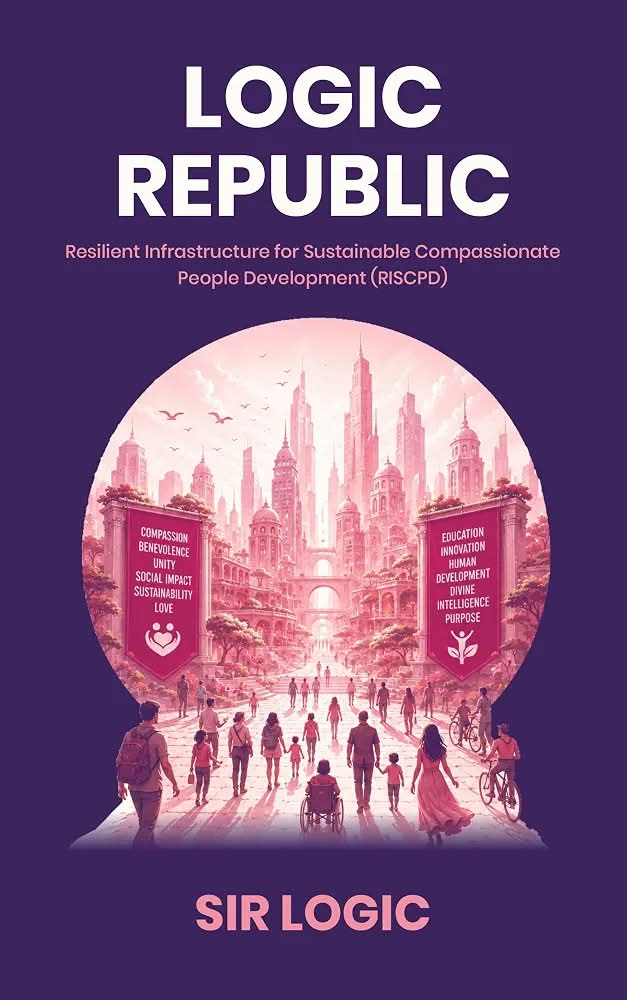
Nigerian author and philosopher, Sir Logic, has published a new book, Logic Republic, in which he advocates a fundamental rethink of how societies approach leadership, economic development, governance and human relationships.

Published by Prima, an imprint of Narrative Landscape Press Limited, the 189-page book explores what the author considers the underlying causes of humanity’s persistent challenges, including poverty, inequality, corruption, poor leadership and declining social cohesion.
Sir Logic, born Prince Caleb Agboji, argues that many of the problems confronting humanity cannot be resolved through conventional economic and political interventions alone. He believes that a fundamental shift in human values, understanding, wisdom and collective responsibility is necessary to achieve sustainable development.
At the heart of the book is the concept of the Logic Republic, a proposed model of society built around Resilient Infrastructure for Sustainable Compassionate People Development (RISCPD) and guided by the principle of the Greater Common Good (GCG). The framework advocates placing collective human advancement above narrow individual interests, with compassion, balance, benevolence, unity and sustainability serving as foundations for societal progress.
In presenting his transformational philosophy, the author contrasts what he describes as the Confused Republic, characterised by greed, corruption, competition and disconnection from purpose, with the Logic Republic, which represents an ideal society driven by shared prosperity and collective responsibility.
One of the book’s central arguments is that poverty should not be understood exclusively in financial terms. Sir Logic describes it as a broader condition of helplessness associated with deficits in understanding, wisdom, balance and leadership.
While conventional development indicators focus on income, consumption and access to essential services, he argues that addressing the underlying human and institutional weaknesses is equally important.
The author introduces the concept of Balance Quotient (BQ), which he considers an important measure of human awareness and judgement. Going beyond the familiar Intelligence Quotient (IQ) and Emotional Quotient (EQ), he argues that the ability to maintain balance is essential to making sound decisions and navigating life’s complexities.
The book also challenges conventional economic thinking through a concept he calls Lucrativism, or compassionate lucrativism. It proposes an economic system in which profitability is connected to social responsibility and human welfare. Under this framework, businesses and institutions are expected to generate financial returns while contributing meaningfully to societal development.
On governance, Sir Logic introduces Manocracy, a proposed framework intended to complement democracy and address what he identifies as weaknesses in existing governance structures. He also advances the principle of AP=NC (All Participation equals No Competition), reflecting his preference for cooperation, inclusion and collective participation over destructive rivalry.
Another important theme is pattern recognition. The author argues that individuals and societies often repeat mistakes because they fail to identify and replace the behaviours and institutional practices responsible for recurring problems. He maintains that meaningful transformation requires creating new patterns capable of replacing destructive ones.
Applied to Nigeria, this perspective raises questions about the sustainability of political and institutional reforms that change officeholders without addressing the practices and incentives that perpetuate poor governance.
Sir Logic, describes himself as a Godist, Humanist, Poli-thinker, Fundamental Scientist and Alternative Historian. According to the author, his investigations into the universe, human existence and the order of things span more than three decades.
He holds a bachelor’s degree in Communication and Theatre Arts from Kogi State University and an MBA from Lagos Business School, Pan-Atlantic University.
Beyond the book, he plans to extend the Logic Republic concept through music and technology as part of a broader effort to communicate and develop his philosophy.
The book, Logic Republic, offers readers an opportunity to interrogate familiar assumptions about wealth, leadership, progress and the purpose of civilisation.
Logic Republic is available on Amazon

