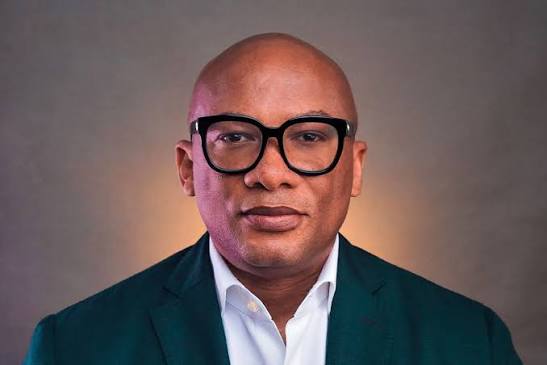
…Mitchell Elegbe on why Nigeria’s biggest advantage is not its challenges, but what it does with them.

By Elvis Eromosele
When Mitchell Elegbe took the stage at The Platform Nigeria on October 1, 2026, he didn’t start with a polished, grandiose manifesto. Instead, he shattered a myth right out of the gate. Did he dream big at the beginning? No, he admitted with a disarming grin. But he executed.
As the Group Managing Director of Interswitch Group. the pioneering payment giant he has led since 2002, Elegbe is a titan of African fintech. Yet his journey began from a very ordinary place of frustration. Back when he worked in business development at Telnet, he had products to sell, but no one was buying. His practical solution was simple: create a company that would buy from you. That initial spark birthed Interswitch. He wasn’t aiming to be CEO; at just 29, with little to no experience, a consultant nudged him into the role simply because it was his idea. A year later, the company was profitable, and that was when the big thinking finally kicked in.
Elegbe’s story serves as a lens for a much larger, paradoxical question facing young Nigerians today: Does it make sense to dream big in a country weighed down by so many challenges?
To answer that, he cast minds back to a global CEO program he attended in Brazil in 2014. A professor dropped a startling prediction: Nigeria would become the 10th largest economy in the world by GDP by 2050. When Elegbe laughed in disbelief, the professor asked a fundamental question. What do the world’s top three economic powerhouses, China, India, and the United States, have in common? It wasn’t religion or geography. It was population. By 2050, Nigeria’s population is projected to hit nearly 400 million. As Elegbe put it, if you have 400 million people, you cannot fail, because the global economy simply cannot absorb the failure of a nation that vast.
That revelation reframes how we view local enterprise. Just as America and China once produced goods associated with low quality before iterating their way to global dominance, a massive local market gives homegrown innovators the runway to build, test, and improve.
Problems, Elegbe stressed, are local, and solutions must be local. Back in 2002, Nigeria’s infrastructure was a minefield. Power flickered, telecom was nascent, and workers spent their days standing in long queues just to collect a tally number to withdraw their own money from banks. Despite warnings that an instant digital payment system would never survive Nigeria’s infrastructure gaps, Elegbe leaned on his training as an engineer: you can design out problems. Today, instantaneous bank transfers and digital alerts are second nature, built on a foundation of trust and sheer grit.
But Elegbe offered a crucial warning against getting trapped in endless ideation. You could spend six months dreaming up a massive enterprise while someone else executes a small idea and scales it. Execution always trumps the sheer size of a dream.
Pointing to a famous 2012 NASA satellite image of Africa plunged in darkness, Elegbe urged the room to see past the excuses. Darkness isn’t a permanent sentence; it’s an untapped canvas of opportunity. Backed by projections from PwC and Goldman Sachs pointing to Nigeria’s rise over the next few decades, he noted that Microsoft Copilot data affirms what we already know: our natural intelligence is second to none, our resources are boundless, and our entrepreneurial spirit leads the continent.
True entrepreneurship, he reminded the audience, is simply the pursuit of opportunity without regard to the resources you currently control. When Interswitch needed ₦450 million at launch, they only secured ₦200 million, yet they hit profitability by year two anyway.
The takeaway for anyone building today is refreshingly grounded. You don’t need a continental blueprint on day one. Start small, fix a local problem, but keep one eye on the future. The foundational decisions you make early on, your team, your systems, your architecture, will determine whether you can eventually scale. Because as Elegbe bluntly put it, growth and scaling are two different things entirely. You can grow revenue, but you can never scale losses.
Eromosele, a corporate communications expert, sustainability advocate, and Lead Coordinator for the Africa Sustainability Forum 2026, writes via elviseroms@gmail.com.