


The Federal Government has unveiled a new National Agricultural Mechanisation Policy and Investment Strategy aimed at modernising Nigeria’s agriculture, attracting private investment and boosting farm productivity.

Minister of Agriculture and Food Security, Senator Abubakar Kyari, unveiled the two policy documents on Wednesday in Abuja at a High-Level National Policy Dialogue on Agricultural Mechanisation.
The dialogue was themed, “Anchoring National Food Sovereignty through Sustainable Agricultural Mechanisation Policy, Innovation and Strategic Investment.”
Kyari said the new framework would move agricultural mechanisation away from a government procurement model towards a sustainable, investment-driven system that can attract capital, technology and entrepreneurship.
He said the government wants to build a “Mechanisation-as-a-Service” economy, allowing farmers to access machinery and other technologies when and where they need them.
According to the minister, mechanisation goes beyond tractors and includes land preparation, planting, irrigation, crop protection, harvesting, processing, storage, logistics and transportation.
“Our responsibility as a ministry is to translate that vision into policy architecture, institutional coherence and practical pathways for investment and delivery,” Kyari said.
He added that the goal was to create an ecosystem where capital, technology, skills and entrepreneurship work together to make mechanisation commercially viable and accessible to farmers.
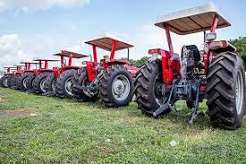
Kyari disclosed that the government had begun procuring and deploying 2,000 tractors, alongside more than 9,000 agricultural implements and spare parts, under the Renewed Hope National Agricultural Mechanisation Programme.
The new investment strategy also provides for a mega tractor assembly plant capable of producing between 2,000 and 4,000 tractors annually.
The facility is expected to reduce Nigeria’s reliance on imported agricultural machinery, strengthen local manufacturing capacity and create jobs.
Kyari also called on young Nigerians and women to take advantage of opportunities emerging from the mechanisation economy.
“Our youths must not stand at the edge of the mechanisation economy. They must own, operate, innovate and lead it,” he said.
Borno State Governor Babagana Zulum, who also spoke at the event, said agricultural mechanisation should not be reduced to the purchase of machinery.
“We must build the agriculture of tomorrow. Agriculture must be mechanised and smart,” Zulum said.
The policy comes as the Federal Government seeks to attract more private capital into agriculture and strengthen food production, processing and distribution.
Through the Special Agro-Industrial Processing Zones programme, the government is targeting $4.4 billion in investment to accelerate agro-industrial development and value addition.
The programme is also expected to strengthen agricultural supply chains, increase exports and improve food security.
The push for greater mechanisation comes against the backdrop of Nigeria’s large food import bill and significant post-harvest losses.
The government has raised concerns that Nigeria spends more than $10 billion annually on food imports, while agro-export earnings remain below $400 million.
Post-harvest losses are also estimated at between 30% and 60% of agricultural produce before it reaches consumers.
The government believes improved mechanisation, processing capacity, logistics and market access can help address these challenges and make agriculture more productive and commercially attractive.
Earlier this year, the Federal Government also approved a N250 billion facility for the Bank of Agriculture to provide financing to smallholder farmers at single-digit interest rates.
The new mechanisation policy is expected to complement such initiatives by expanding access to agricultural machinery while creating greater opportunities for private-sector investment.
The government’s broader objective is to build a more productive and commercially sustainable agricultural sector capable of improving food security, creating jobs and reducing Nigeria’s dependence on imported food and agricultural equipment.
