


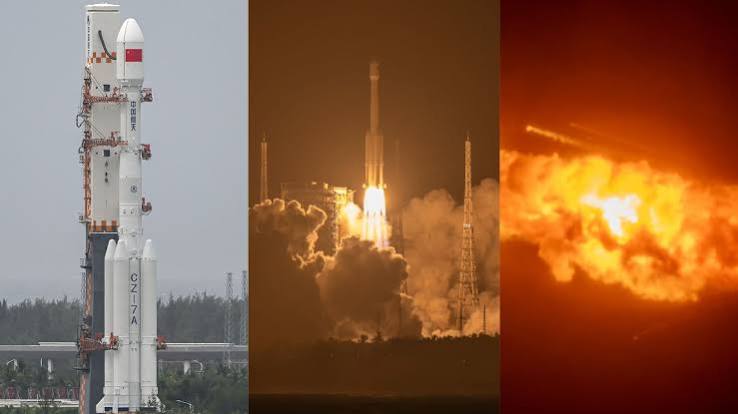
A Chinese Long March 7A rocket carrying a communications satellite exploded just 85 seconds after liftoff on Monday, marking a rare failure for one of the country’s established satellite-launch vehicles.

The rocket erupted into a massive fireball shortly after taking off from the Wenchang Space Launch Site on Hainan Island, according to video footage of the incident.
China’s state news agency, Xinhua, confirmed the failure about three hours after the launch, saying the rocket “experienced an anomaly during flight.” It said the cause of the failure was under investigation.
The incident occurred during the rocket’s planned 18th mission. The Long March 7A had previously recorded only one failure, during its maiden flight in 2020.
The rocket was carrying the Zhongxing-4B, also known as ChinaSat-4B, a communications satellite designed to provide radio, television and other communications services to users around the world, according to Chinese state media.
Videos posted online showed the rocket breaking apart in the sky shortly after 8 p.m., with spectators heard gasping as the launch ended in an explosion.
The Long March 7A is a three-stage satellite launch vehicle developed by the China Academy of Launch Vehicle Technology, a subsidiary of the China Aerospace Science and Technology Corporation, the country’s main state-owned space contractor.
The rocket measures about 60 metres in length and has four boosters. It is capable of carrying up to seven metric tonnes of payload into geostationary transfer orbit.
The failure comes as China continues to expand its space programme and compete with the United States in areas including satellite launches, lunar exploration and reusable rocket technology.
Chinese President Xi Jinping has set an ambition for the country to become a global leader in space science by 2050.
The Long March 7A incident also came at a critical time for China’s developing reusable rocket programme.
A planned launch of the Zhuque-3, developed by private Chinese rocket company LandSpace, was reportedly delayed following Monday’s failure.
The Zhuque-3 is considered one of China’s most significant attempts to develop a reusable launch vehicle. During its first flight in December 2025, its first stage caught fire before crashing near the intended recovery area.
Last month, however, China successfully recovered the first stage during a subsequent test, marking a major milestone in its reusable rocket programme.
Unlike the Zhuque-3, the Long March 7A is not designed for reuse.
The explosion received relatively limited coverage in China’s state media immediately after the incident.
Xinhua’s brief confirmation provided no details about what caused the failure, saying only that an anomaly had occurred during the flight and that an investigation was underway.
Reports also indicated that some videos posted by users on Chinese social media platforms were removed or became difficult to find.
The incident nevertheless attracted international attention, with SpaceX founder Elon Musk commenting on X: “Rockets are insanely hard.”
The launch took place at Wenchang, one of China’s major space-launch centres. The area is also a popular destination for space enthusiasts, with residents and tourists often gathering at designated viewing locations to watch rocket launches.
The Long March 7A’s failure is expected to prompt further investigation into the vehicle and could provide important lessons for China’s growing launch programme as the country increases the frequency and complexity of its space missions.
For now, Chinese authorities have not disclosed the specific cause of the failure or provided details on whether the incident will affect future Long March 7A launches.
