


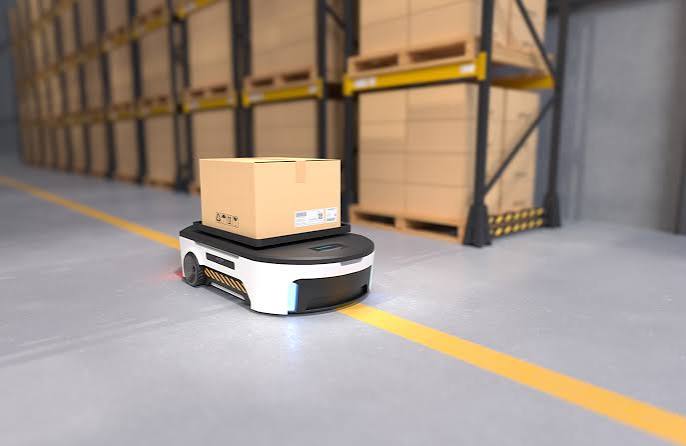
Chinese robotics company Geek+ is rapidly expanding its footprint in the United Kingdom, supplying autonomous warehouse robots to some of the country’s biggest retailers as businesses increasingly turn to automation to improve productivity and address labour shortages.

The company’s robots are now operating in warehouses used by major retailers including Tesco, Asda and Next, where they help process online orders by transporting shelves and pallets to warehouse staff for picking and packing.
At Geek+’s manufacturing facility in Hefei, eastern China, fleets of autonomous mobile robots are assembled, tested and shipped to distribution centres across the world, including the UK.
Unlike traditional warehouse automation systems that require extensive conveyor belts and permanent infrastructure, Geek+’s robots navigate warehouses using QR-code floor markers and safety barriers.
The company says the technology enables retailers to process orders more quickly, maximise storage space and reduce picking errors while improving overall warehouse efficiency.
Geek+, which became the world’s largest supplier of autonomous mobile robots, further strengthened its market position after listing on the Hong Kong Stock Exchange in one of the biggest robotics initial public offerings of 2025.
The company is also investing in the development of humanoid robots capable of carrying out more advanced warehouse tasks such as picking and packing products.
The growing adoption of warehouse robotics comes as the UK continues to grapple with weak productivity growth that has persisted for more than a decade.
According to the Organisation for Economic Co-operation and Development (OECD), wider use of robotics and automation will be critical to improving business efficiency, particularly among small and medium-sized enterprises.
In its 2026 report on technology adoption, the OECD described Britain’s relatively low use of robotics as surprising, given the country’s long manufacturing history. While UK businesses have embraced digital technologies, they continue to lag behind many competitors in automation.
The report suggests this gap presents significant opportunities for robotics companies as the UK’s large e-commerce and logistics sectors continue to modernise.
Britain has already emerged as Geek+’s biggest market in Europe.
Its UK partner, MotionTech, has deployed more than 2,000 robots across 10 warehouse sites, supporting retailers seeking faster and more flexible fulfilment operations.
“Customers want fast deployable solutions,” said Barry Pemberton, Account Director at MotionTech.
“They want high volume, high storage, fast picking… ultimately on a smaller footprint with a reduced headcount.”
He added that labour shortages across the UK have made warehouse automation increasingly attractive for businesses trying to meet growing consumer demand.
The rise of robotics has also reignited debate about the future of work.
The Trades Union Congress (TUC), which represents nearly six million workers, says automation should be used to improve productivity and working conditions rather than simply replace employees.
The union has urged the UK government to ensure workers are involved in decisions about automation while encouraging employers to invest in retraining programmes that equip staff with new skills.
Geek+’s global expansion reflects China’s broader push to become a world leader in robotics and advanced manufacturing.
Under President Xi Jinping’s strategy to develop what Beijing calls “new quality productive forces,” robotics has become a national priority as China seeks to offset the effects of a shrinking working-age population and sustain its manufacturing competitiveness.
Analysts say China’s dominance in electric vehicle production has accelerated growth in robotics, with technologies such as batteries, electric motors, sensors and semiconductors increasingly being adapted for autonomous machines.
As demand for faster e-commerce fulfilment continues to rise worldwide, Chinese robotics companies are positioning themselves at the centre of a rapidly evolving global logistics industry.

