


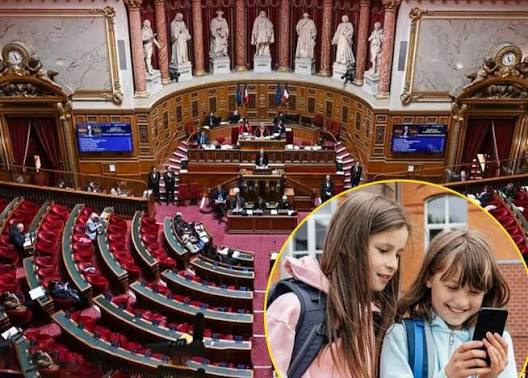
France has become the first European country to approve a nationwide ban preventing children under the age of 15 from accessing social media, as lawmakers intensify efforts to protect young people from the platforms’ potential harm.

The legislation, passed by both the French Senate and National Assembly on Tuesday, will take effect in two phases, culminating in January 2027 when every social media user in France will be required to verify their age before accessing platforms.
President Emmanuel Macron, who had pledged to introduce the measure before the end of his presidency, welcomed the law as a major step toward safeguarding children’s mental health in the digital age.
The new law will be implemented in stages:
- From September 2026: Children under 15 will no longer be allowed to create new social media accounts, while all new users will be required to undergo age verification.
- From January 2027: The age verification requirement will extend to all existing accounts, meaning every social media user in France must prove they are at least 15 years old to continue using the platforms.
Social media companies will be required to deploy age-verification systems approved by France’s data privacy regulator.
Despite broad political backing, the legislation has sparked debate over privacy, enforcement and its practical effectiveness.
Critics argue that age-verification systems could expose users to privacy risks, while determined teenagers may still find ways to bypass restrictions. Others have questioned the speed with which the legislation was drafted and approved.
French Digital Minister Anne Le Hénanff defended the accelerated timeline, arguing that reliable age-verification technologies are already available and can be implemented safely.
France follows Australia, which introduced a ban on social media access for under-16s in December.
However, Australia’s experience has highlighted the challenges of enforcing such restrictions. Earlier this year, the country’s eSafety Commission reported that seven in 10 children who had social media accounts before the ban continued to have some level of access.
Internet studies expert Professor Tama Leaver of Curtin University described Australia’s ban as falling short of its technical objectives but said it demonstrated that large-scale restrictions are possible.
He suggested France’s requirement for universal age verification could improve compliance but warned it also raises greater privacy concerns. He added that excluding young people from mainstream platforms could push them toward less-regulated online spaces while limiting their access to news and civic engagement.
France’s move comes as governments across Europe introduce tougher measures to protect children online.
In the United Kingdom, former Prime Minister Sir Keir Starmer announced that under-16s will also be barred from social media beginning in January 2027, alongside an optional midnight curfew for users aged 16 and 17.
At the European Union level, European Commission President Ursula von der Leyen has proposed a continent-wide “social media delay” for children, with new legislation expected to be considered in the coming months.
France’s decision places it at the forefront of Europe’s push for stronger online protections, setting the stage for what could become a broader shift in how governments regulate children’s access to social media.

