


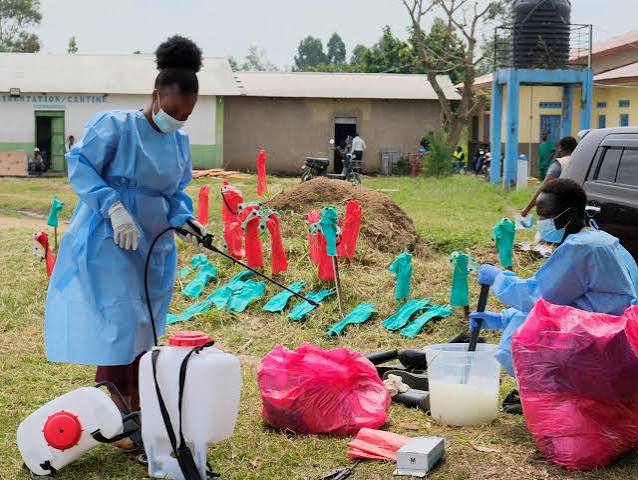
The Ebola outbreak in the Democratic Republic of Congo (DRC) has intensified sharply, with the death toll doubling in just over two weeks and confirmed infections exceeding 2,000, underscoring what the World Health Organisation (WHO) has described as its fastest-growing Ebola outbreak.

Latest figures released on Tuesday by the DRC’s National Institute of Public Health show 754 confirmed deaths and 2,011 confirmed cases. The outbreak, caused by the Bundibugyo strain of the Ebola virus, has now spread beyond its original epicentre in Ituri Province into two additional provinces.
The surge comes as health authorities race to contain the virus while researchers begin clinical trials aimed at finding effective treatments for the Bundibugyo strain, which currently has no approved vaccine or targeted therapy.
The WHO believes the actual scale of the outbreak could be far worse than official statistics indicate.
According to Dr. Chikwe Ihekweazu, Executive Director of the WHO Health Emergencies Programme, the real number of infections may be two to four times higher, as many cases are not being detected through existing contact-tracing efforts.
He noted that about 80 per cent of newly identified cases are emerging outside known contact lists, making it increasingly difficult to contain transmission.
“You have to imagine that this is a fire,” Ihekweazu said. “We’ve seen the fastest growth in a single month since the outbreak started and of all the Ebola outbreaks that we have managed.”
The WHO also reported that the outbreak has become more lethal, with the case fatality rate rising to 37 per cent, up from 32 per cent a week earlier.
Health officials attributed the higher mortality rate not to a more virulent strain but to delayed detection and treatment. An analysis of 430 confirmed deaths found that 92 per cent of patients died before reaching treatment centres.
“We must find the cases earlier, bring them into care as soon as possible so that we reduce transmission in the community,” Ihekweazu said.
The outbreak has also infected foreign humanitarian workers operating in the DRC, raising concerns about international spread.
Last week, the U.S. Centers for Disease Control and Prevention (CDC) confirmed that an American aid worker contracted the Bundibugyo strain while working in the DRC. The agency also referenced an earlier case involving another American humanitarian worker who was evacuated to Germany for specialist treatment.
Germany confirmed on Monday that another infected American had been transferred from the DRC to Frankfurt University Hospital for treatment, while the U.S. government has temporarily restricted official travel by its personnel in the DRC because of the worsening outbreak.
Beyond its public health impact, the outbreak could inflict significant economic losses if it spreads further across Africa.
The United Nations estimates that if the virus remains largely confined to the DRC and neighbouring Uganda, the Congolese economy could lose about $1 billion in gross domestic product (GDP).
However, the UN warned that a wider regional outbreak involving countries such as Rwanda and Angola, combined with elevated global energy prices, could cost Africa as much as $3.6 billion in economic output and lead to the loss of more than 328,000 jobs.
Health authorities continue to urge early detection, rapid isolation of infected patients and stronger surveillance as they work to bring the rapidly expanding outbreak under control.

