


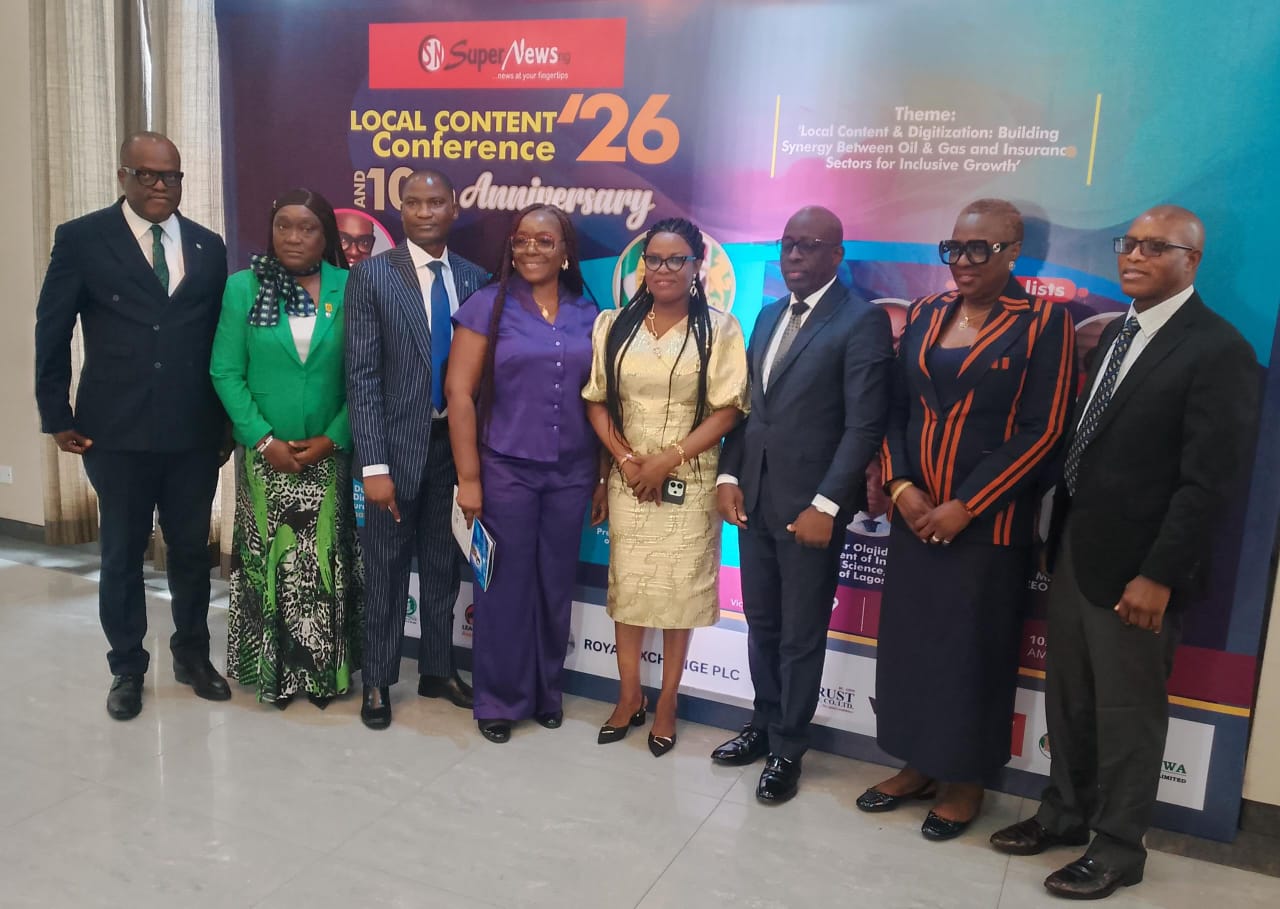
Industry leaders and experts have called on regulators in Nigeria’s oil and gas and insurance sectors to establish a joint task force to drive implementation of critical reforms, saying stronger local capacity, enhanced collaboration and increased investment in reinsurance are essential to achieving the country’s 2030 local content and energy sector goals.

The recommendations emerged from a panel discussion at the SUPERNEWS Local Content Confab’26 and 10th Anniversary Celebration in Lagos, where stakeholders stressed that the time had come to move beyond discussions and begin implementing practical solutions.
Dr. Nneka Obi, Managing Director/Chief Executive Officer of Deepshores Energy Limited, led the call for immediate action, urging regulators from both industries to work together through a dedicated implementation team.
“There is no need for us to keep talking,” she said. “The question is, who will actually implement everything we have discussed?”
Obi proposed that the two regulatory bodies establish a joint task force to coordinate industry reforms, improve compliance and create greater value for both sectors. “If the two bodies work together, it will be cost-effective and beneficial. It will add value to both the oil and gas industry and the insurance industry,” she said.
She also urged stakeholders to set measurable targets with clear timelines rather than waiting for perfect conditions. “We keep talking about achieving our 2030 goals. What exactly are we waiting for? We should roll out action plans with clear deadlines. Growth is not a sprint; it is a marathon. The important thing is that we continue moving forward.”
Obi also encouraged students and young professionals to participate actively in industry engagements, noting that they represent the next generation that will sustain both sectors.
Dr. Adaobi Nwakuche, Managing Director/Chief Executive Officer of Veritas Kapital, said developing local technical expertise should be a national priority, given the highly specialised nature of oil and gas operations. She was represented by Sunkanmi Adekeye, Executive Director, Operations, Veritas Kapital.
She recalled an incident where local professionals were unable to carry out recovery work because of the physical and technical complexity involved.
“The opening was too small, the space too narrow and the depth too great, making recovery extremely difficult,” he said. “We had to bring in foreign experts to carry out the adjustment work. That speaks to the complexity of the oil and gas sector.”
According to him, capacity building must go beyond general training to focus on specialised skills tailored to the industry’s unique challenges. “We need to develop specialised expertise so that the complex challenges we experience, especially in oil and gas, can be handled properly,” he said.
Adekeye identified collaborative regulatory frameworks and capacity building for managing complex risks as the two critical areas that require urgent attention to strengthen cooperation between the insurance and oil and gas industries.
Also speaking, Prof. Olajide Solomon Fadun of the Department of Actuarial Science and Insurance, University of Lagos, said collaboration should extend beyond insurers and oil companies to include regulators, technology firms, academia and other stakeholders.
“The collaboration we are talking about goes beyond just the insurance and oil and gas industries,” he said. “Technology assets cannot be handled by the insurance industry alone, while financial assets also require expertise from other sectors.”
Fadun identified weak local reinsurance capacity as one of the major challenges limiting Nigeria’s insurance industry’s ability to support large-scale oil and gas risks.
“As an industry, we need to improve our reinsurance capacity,” he said, noting that the country has only a few reinsurance companies despite the large number of insurers operating in Nigeria.
He urged the National Insurance Commission (NAICOM) to encourage greater investment in local reinsurance firms, arguing that stronger domestic capacity would reduce reliance on offshore reinsurance and keep more insurance premiums within the Nigerian economy.
The insurance expert also advocated greater adoption of predictive risk management, explaining that modern insurance practice has shifted from merely paying claims after losses occur to proactively identifying risks before incidents happen.
According to him, analysing clients’ operations, identifying potential vulnerabilities and recommending improvements would reduce losses, lower claims and improve underwriting profitability.
In all, the speakers highlighted key recommendations, including the establishment of a joint implementation task force, stronger local capacity to manage complex oil and gas risks, enhanced capital to deepen the insurance market, greater transparency, increased product innovation, wider adoption of technology, collaborative regulatory frameworks and stronger partnerships across the entire oil and gas and insurance value chain.
Participants agreed that implementing these measures would strengthen local content, improve Nigeria’s insurance capacity for the energy sector and accelerate progress towards the country’s 2030 development objectives.

