

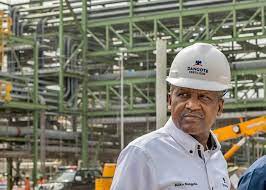
Dangote Refinery has reached its full operational capacity of 650,000 barrels per day (bpd), marking a major milestone for the $20 billion industrial project and positioning it as one of the largest single-train refineries in the world.
The company confirmed that following optimisation of critical processing units and a successful 72-hour performance test run, the facility is now capable of supplying up to 75 million litres of petrol daily to Nigeria’s domestic market, up from the 45–50 million litres distributed during the recent festive season.
David Bird, Chief Executive of Dangote Refinery, said the refinery completed extensive performance validation in collaboration with technology licensor UOP, a Honeywell company, covering the Crude Distillation Unit (CDU), naphtha hydrotreater, isomerisation unit and reformer unit. “Our teams have demonstrated exceptional precision and expertise in stabilising both the CDU and MS Block. This milestone underscores the strength, reliability and engineering quality that define our operations,” Bird said.
The development could significantly reduce Nigeria’s decades-long reliance on imported refined petroleum products. Despite being Africa’s largest crude oil producer, the country has historically depended on imports due to the chronic underperformance of its four state-owned refineries, which have a combined capacity of 445,000 bpd but have operated far below capacity for years.
Industry analysts describe the refinery’s achievement as a validation of Aliko Dangote’s long-delayed ambition to transform Nigeria into a refining hub.
Construction of the project began in 2016 and faced multiple setbacks, including foreign exchange challenges, pandemic disruptions and technical delays.
With full-scale operations underway, the refinery is expected not only to meet domestic demand but also position Nigeria as a potential net exporter of refined products to West Africa.
Beyond petrol production, the facility also produces diesel, aviation fuel and polypropylene, supporting Nigeria’s manufacturing and petrochemical sectors.
The refinery has generated thousands of direct jobs and boosted activity across maritime, logistics and ancillary industries.
However, challenges persist. The refinery has reportedly struggled to secure sufficient crude oil supply locally, forcing it to import feedstock. Questions also remain around pricing and distribution in Nigeria’s evolving subsidy and deregulation framework.
Bird said Phase 2 performance tests for additional processing units will commence next week, signalling further optimisation efforts.
He reaffirmed the refinery’s commitment to strengthening Nigeria’s energy security and driving industrial growth.
As global refining capacity faces pressure from energy transition policies and shifting demand patterns, analysts say the scale and efficiency of the Dangote Refinery make it a strategic asset for Nigeria and Africa’s broader industrial future.
